Vegan Cooking Classes
in
Jaipur
for Foreign
Tourists
-
Learn Vegetarian Indian Cooking
(High
Quality intensive Cookery Classes & Crash Courses in
Jaipur for Tourists by a female Chef
since year 2000)
|
Indo
Vegan & Vegetarian Cooking
classes in Jaipur (India) are most suitable for individuals and
groups from foreign countries. Our intensive cooking
classes are designed for non-Indian nationals to enable
them to cook Indian food easily in their own kitchen
back home.
The cooking lessons are conducted and explained in such
a way that you would not need any special utensils or
will have to invest many hours for preparation. The Goal
of our cooking classes is to teach you the basics of
Indian cooking in such a simplified way so that you can
use the cooking skills very often at home. The Indo
Jaipur cooking classes include numerous demonstrations
and hands-On teaching of various basic and famous Indian
Dishes.. There is a Question
Answers session during the course and you are
encouraged to ask questions and Cook Indian food
yourself under the supervision.
During the
cooking classes, you will be taught to cook different
Indian dishes with the appropriate use of typical Indian
spices as they are used in a typical Indian Kitchen. We
offer two options of Vegetarian (no meat) Indian Cooking
Classes in Jaipur to choose from: |
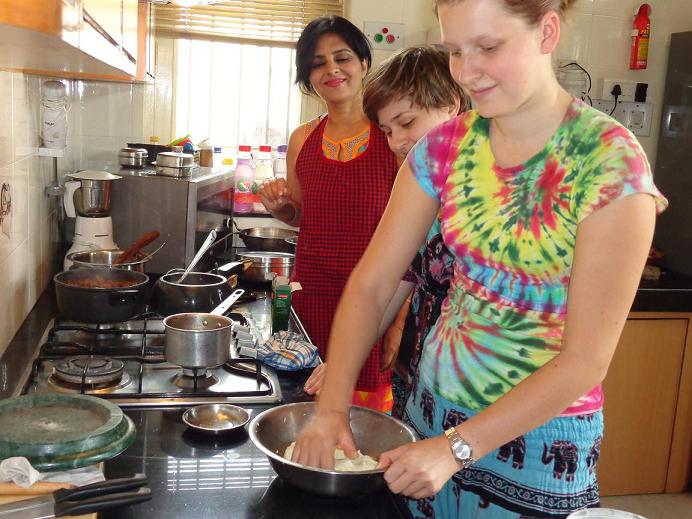 |
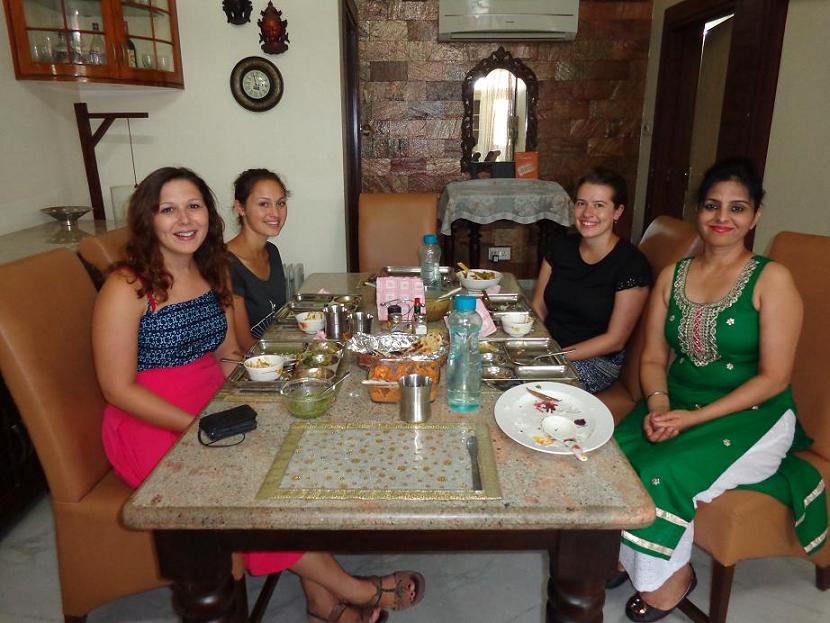 |
|
Option 01: Basic Indian
Vegan / Vegetarian Cooking Session
(around 03 hours in a modern hygienic Kitchen, Starting
at 10.30 AM, Rs. 3000 / Person)
These basic classes are very
reasonably priced and can be done by individuals as well
as by small groups. This cooking class is ideal for
beginners and for those who just want to give it a try
to Indian vegetarian cooking. In this cooking class.
You will be taught the following indian vegetarian
Dishes.
- One DAAL DISH / DAAL FRY
- BUTTER PANEER MASALA
- DRY VEGETABLE ALOO GOBI
- SIMPLE CHAPPATI, PARANTHA,
ALOO PARANTHA
- GREEN CHUTNEY
- SWEET LASSI DRINK
- VEGETABLE RICE (PULAV)
Option 02: Intensive
Vegan / Vegetarian Indian Cooking
Class
(around 05 hours in a modern
hygienic Kitchen, Starting at 10.30 AM, Rs.
4500 / Person)
In
one-day intensive cooking class, you will be taught many
Indian vegetarian dishes, Naan, Roti, simple & stuffed
Roti, Parathas (Indian Breads) as well as Indian sweet
/ Snack / Chutney (sauce), etc. so you learn to cook up
to 09 dishes in one cooking session. You will be
encouraged to involve yourself actively in the Kitchen
under the Guidance of our Cooking Teacher. You will
enjoy a lavish lunch with the cooking teacher with a
detailed explanation.
.
Please send us
an
email
to check the availability for your dates and t for your
individual Intensive Indian Cooking class in Jaipur. Our
vegetarian cooking classes at
Jaipur
Centre
take place from 10.30 till 14.00. (Monday to Saturday ).
Afternoon & Sundays Cooking Classes are available only
on special request. Options 1 & 2 both include the
following:
-
Cost of all the Ingredients, Vegetables, Spices
-
The fee of
the cooking instructor, Cooking Literature / Indian
Cooking Recipes
-
Visit
of local Spice and Vegetable Market or
Bazar (if desired)
Option 03: Vegetarian / Vegan Indian Cooking
Weekly / monthly courses
(around 07 hours in a modern
hygienic Kitchen, Starting at 10.30 AM,
please send us
email
to get the cost
Longer Indian
cooking courses for one week or more are available.
These Indian Cooking Courses are done mostly by
foreigners who wish to learn Indian cooking thoroughly
and won't be comfortable with the use of typical Indian
Spices while cooking at home or as chefs in their
country. For Foreign Chefs, courses for up to one month
are organized and you will get to interact with
different specialized Indian Chefs from different
states. During longer cooking sessions your stay can be
organized with the cooking Instructor in a very well
furnished & comfortable high standard
Apartments. Please send us an
email to check the availability and charges
for weekly / monthly cooking classes by a native chef in
India.
You may call
the cooking instructor (Suman) at
+91 97843
56686 (WhatsApp)
for urgent bookings or any clarification needed. (For
advance bookings and general Queries communication is
preferred via email as the cooking instructor may be in
the middle of a cooking session while you call).
Bookings should be done in advance! Please feel free to
inform us of your wishes as this would enable us to make
the best out of the cooking Training Session. We look
forward to welcoming you to the tastes of Indian Spices
at Indo Cooking Classes by Suman in Jaipur at Indo
Cooking Classes!
|
|
Indian Food Cooking
Classes in Jaipur, India - Images Gallery.... |
Indian Vegan / Vegeatrian Cooking
classes, Jaipur - Details of long
duration Indian Cooking Courses for
Foreigners at Jaipur (Rajasthan -
India)
|
|
Indo Cooking
classes are most suitable for individuals and groups.
Our Indian Cooking classes are designed for non-Indian
nationals who wish to learn the original Indian cooking.
We offer to stay at the cooking Teacher's home during
the cooking course. The aim of these classes remains to
enable beginners to cook on their own using the basic
spices available in their home country. Professionals
are given help to polish their already existing
knowledge and there are guided into the depth of Indian
spices and cooking secrets. The ancient cooking secrets
are revealed to enrich your real Indian cooking
experience. Our cooking classes include numerous
demonstrations and teaching of Indian cooking as well as
many Question – Answers sessions during the course with
our Expert cooking Instructor.
There is a minimum one-day course and a maximum of two
months. Most common among our Students are one-day or
one-week courses which can be taken individually as well
as in a group. If you intend to bring some more people
with you there will be a discount for group cooking
sessions.
In our cooking classes, you will be taught to cook
different Indian dishes with the appropriate use of
typical Indian spices as they are used normally in an
Indian Kitchen. You will be taken care of by a female /
Male Professional Indian cook who has had many years of
cooking teaching experience. Most of our Course
Participants are able to cook after the
course independently on their own in their home country. |
|
Below is the
general information about the cooking course offered by
us. If you still find any of the questions unanswered
please let us know and we would get back to you. We
offer cooking sessions for individuals and groups in the
city of Jaipur (Jaipur is the capital of Rajasthan
(India) and is around 250 km. away from Delhi or Agra (Taj
Mahal). If you are traveling only for learning the
Indian cooking you can travel any time and the classes
can be organized. However, we recommend checking if the
wished dates are available with us as during the high
seasons our private one-on-one cooking classes may be
booked very well in advance.
You may find
below information about our cooking classes useful:
-
We offer the
one-day crash course (4 hours) as well as a
demonstration of Indian cooking.
-
We also offer
five days course (with the one-week accommodation
option) to one month course (which can be extended for
any time duration) in the homely kitchen of a cooking
teacher where you will be taught the basics as well as a
few North Indian dishes. The choice of the dishes to be
learned can be decided with mutual understanding with
the cooking Instructor (the time period or duration can
be extended if we have the dates available).
-
Our cooking
sessions take place from 09.30 AM till 8.00 PM (Special
Evening sessions and Sundays classes are available on
request.
-
There will be
a lavish Lunch with the Teacher after the cooking
session – the time during the lunch can be used for
question – answers sessions.
-
There is
also an option of staying with the cooking teacher
(subject to availability of the accommodation on the
given dates ), the accommodation would be with a private
toilet and bath of your own - a sample accommodation can
be viewed
here!
-
The cost
of the cooking classes with the stay at the cooking
teacher differs according to low and high season and as
per the availability of the accommodation type Please
send us an
email with the dates to
get more information on this.
If you
decide to have a longer stay with the cooking teacher -
the cooking training package will include:
-
Cost of all
the Ingredients, Vegetables, Spices
-
The fee for
the Cooking instructor, cooking literature
-
Accommodation
(You will be provided your own air-conditioned room and
a private bath)
-
Access to wifi
internet, TV in your room
-
Laundry
facility once a week
-
All meals,
tea, coffee, etc. in the premises
Jaipur
International is the nearest airport to the cooking
school and we / our Driver will pick you up from the
Airport and drive you to the host family. We can also
get you picked up from the Delhi International Airport
During the half-free days we can plan for you a tour
itinerary at a reasonable cost which would include some
sightseeing points in and around Jaipur. Should you be
interested in touring further into Rajasthan or India we
can extend your tour itinerary.
For those who are unable to travel to India to learn
Indian cooking, we also offer courses through live
online video teaching.
Currently, we are offering Indian cookery classes not
only in Jaipur but also in different cities in India,
Nepal & Sri Lanka. Please do share your dates for other
cities and we would be glad to send you the relevant
information.
You may also have a look at the
references
from many different countries.
The cost of the Classes may vary
according to the chosen time and would be subject to the
availability of our expert native cook. Please send us
an
email and we would get back to you with
further cooking classes details.
|
|
Indian Food Cooking
Classes in Jaipur, India - Images Gallery..... |
|
Our
Location:
Plot no.
312 A (Near Pushpawali Nursery Premises),
Valmiki Marg, Raja Park, Jaipur (Rajasthan), INDIA
Contact Person: Ms. Suman (Mobile: 0091 97843 56686 or
Landline at 0091 141 4013241)
Click here to email
Click here to see exact Location |
|
|
|
|
|
New
!
For those who are unable to travel to India to learn
Indian cooking, we also offer courses through live
online video teaching where you are taught online with
the help of a web Camera by an expert native teacher.
Should you be interested in these options we would be
glad to send you further details. Please email us your
dates.
|
|
|
|
Indian Food has been rated by most cultures as one of the best
food available. Especially for vegetarians, the travel to India
is half worth only for enjoying the Indian food with its rich
varieties. Indian restaurants have been flourishing in the
capitals of the world and thus, Indian cuisine is no longer a
mystery. In the UK, Indian curry is the third most popular dish
among the Britishers. Among the Japanese, the curry rice is
relished quite a lot and it is the second most popular dish
according to a recent survey. The UK has more than 1000 Indian
restaurants and the USA, Canada, and Japan have over 100
restaurants each. India attracts over 5 million foreign visitors
every year for an average stay of one month. Indian Cuisine is
also gaining more popularity due to its rich taste, exotic
flavor, and healthy preparation. Indian cuisine has a very good
taste which is designed not only to satisfy the taste buds but
also the human psychology. Indian cuisine is easy to prepare,
tasty, and can be prepared in less time. Spices are the main
part of Indian cooking and their quantity and proportion vary
with the geographical boundaries. Spices are freshly grounded
and added in many different combinations. Some of the spices
which are commonly used are coriander, turmeric, cumin, chilies,
fennel, and fenugreek. Other spices which are added for some
fragrances are cardamom, clove, cinnamon, and star aniseed.
|
|
|
|
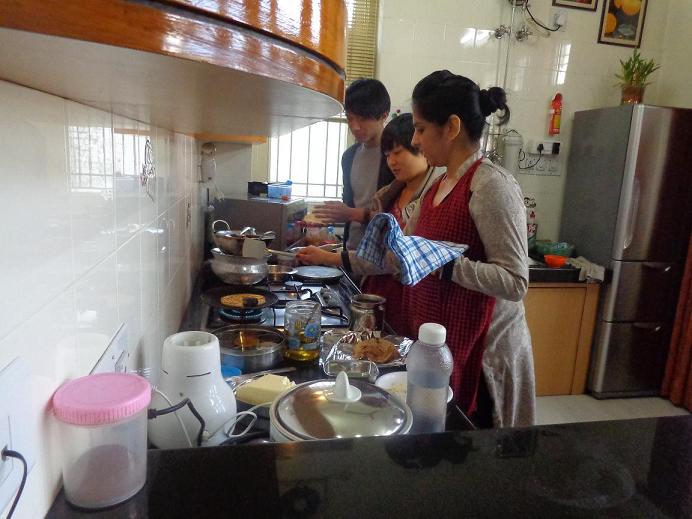
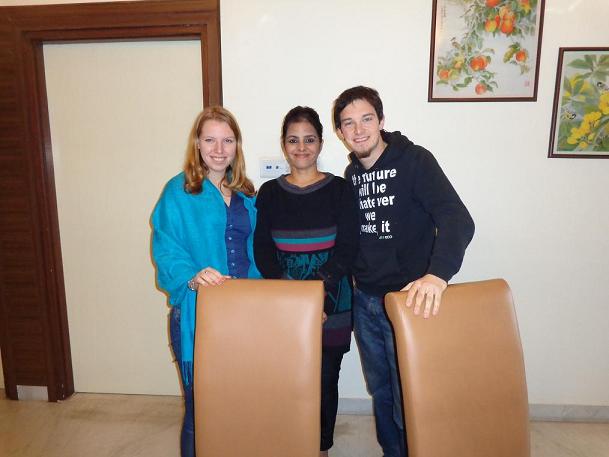
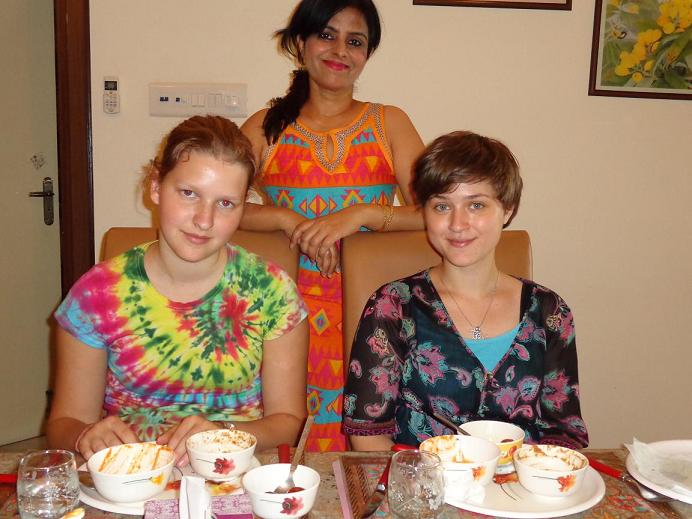
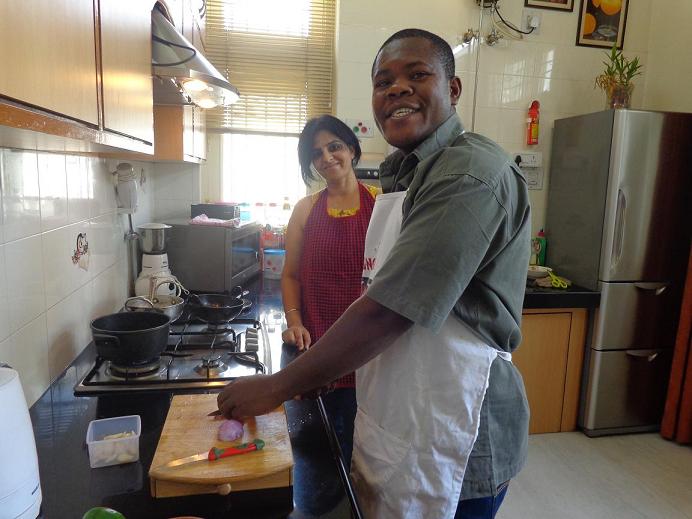
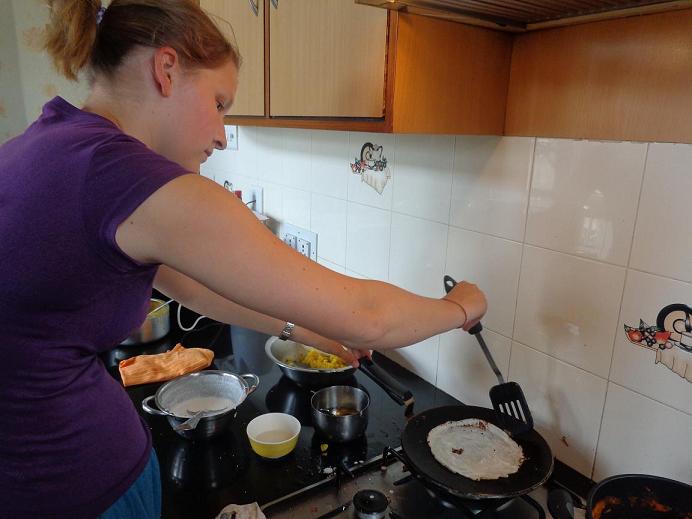
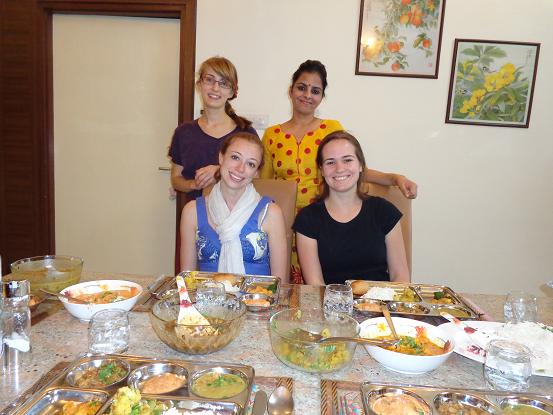
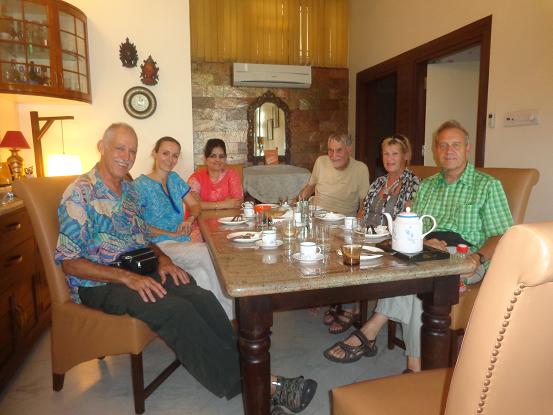
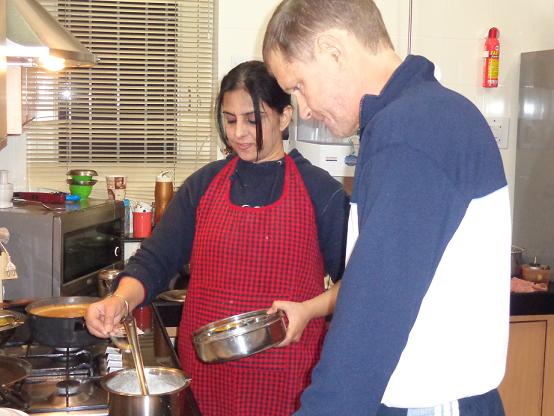
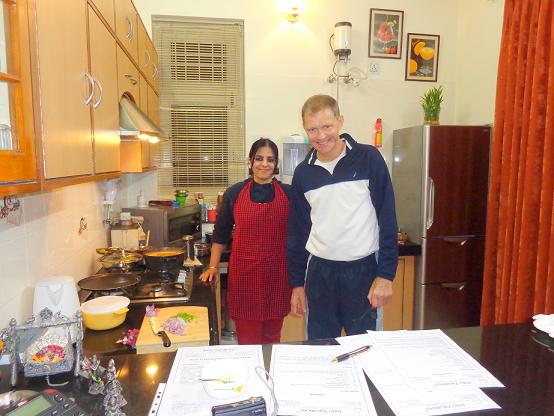
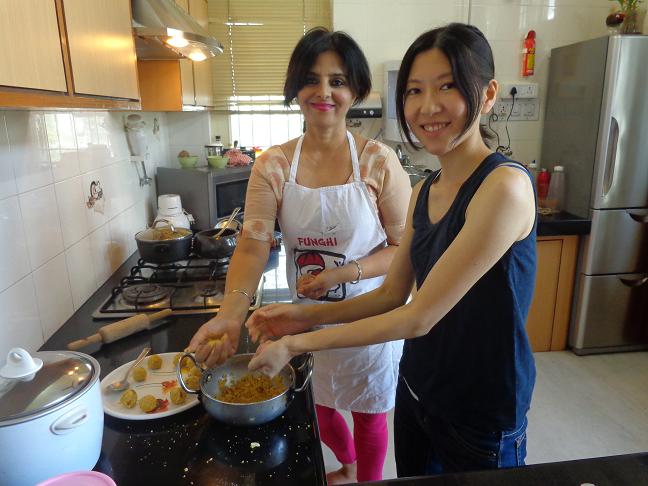
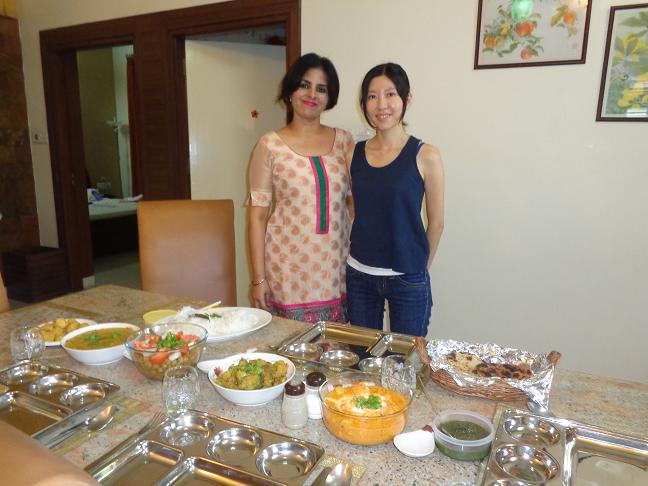
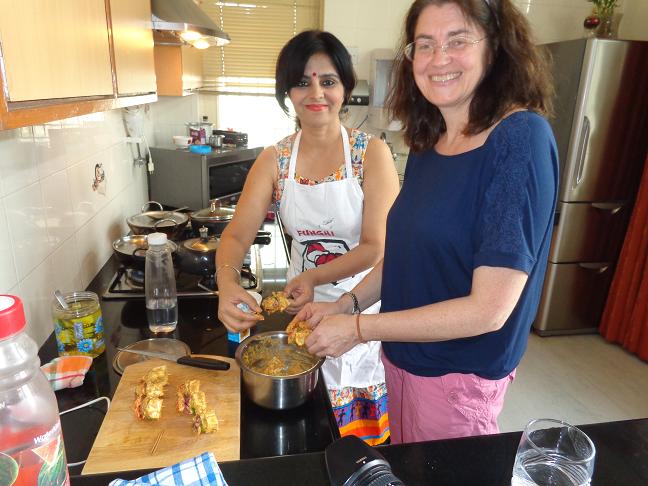
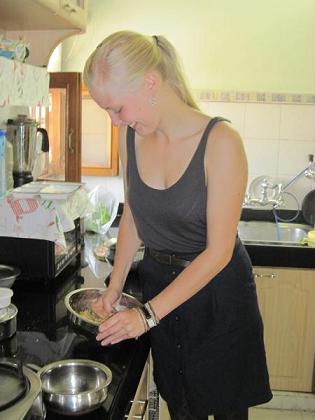
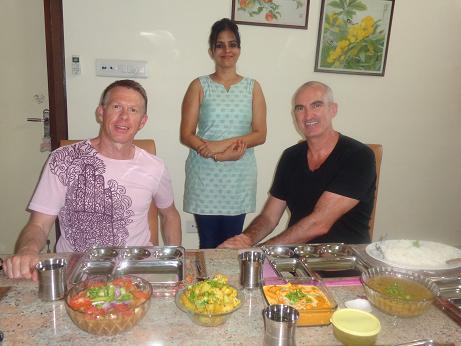
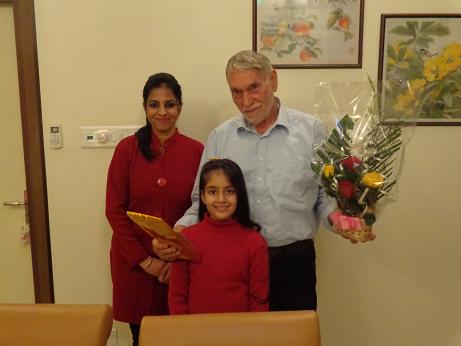
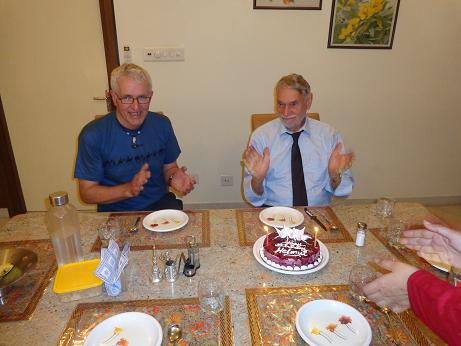
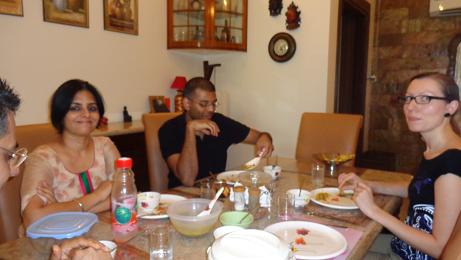
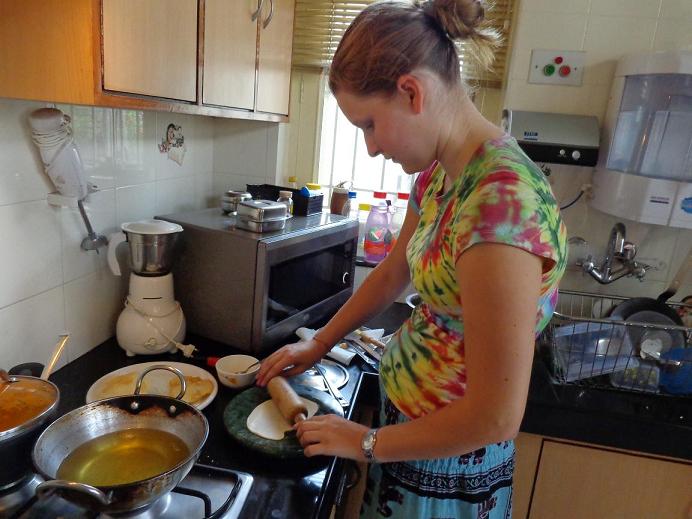
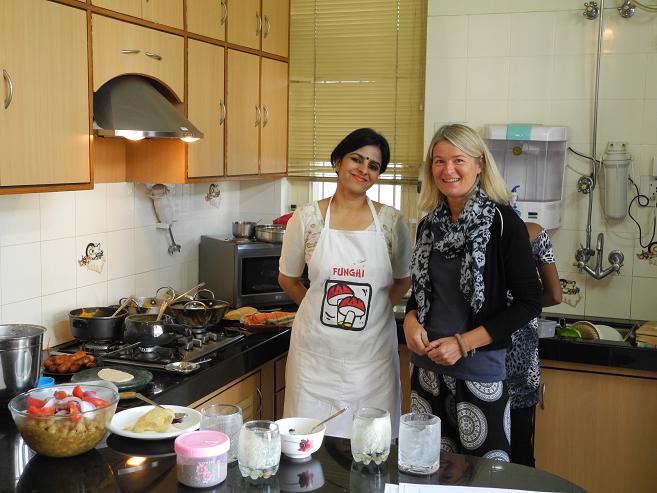
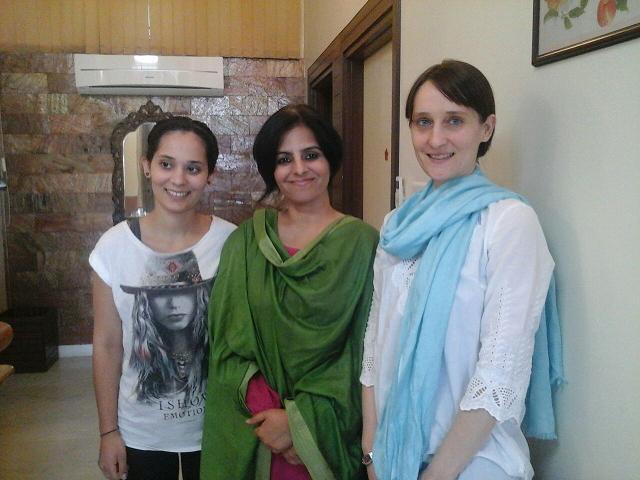
Individual
Indian Vegan Cookery Classes in India
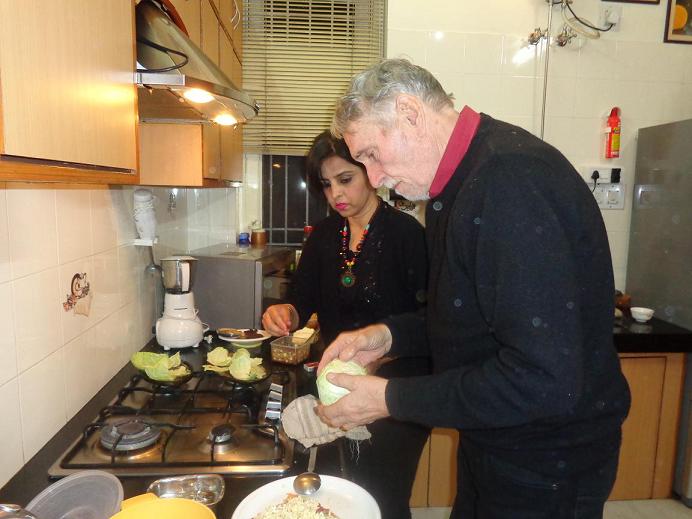
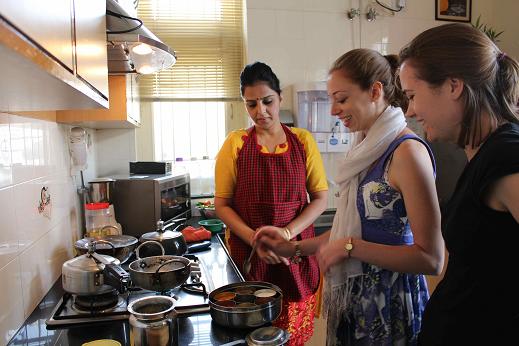
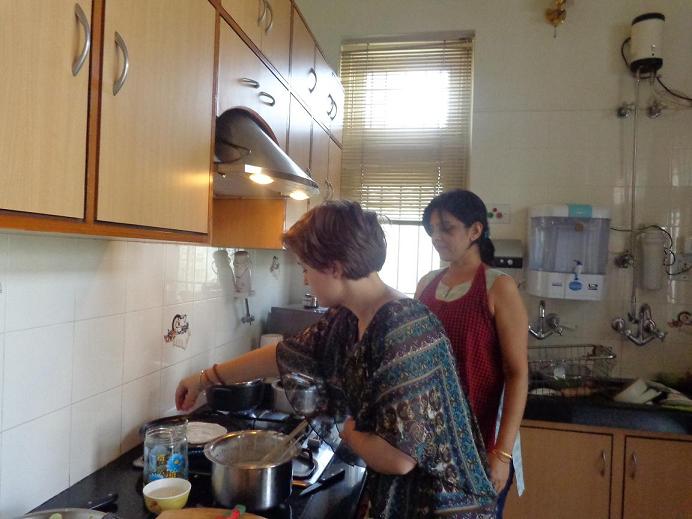
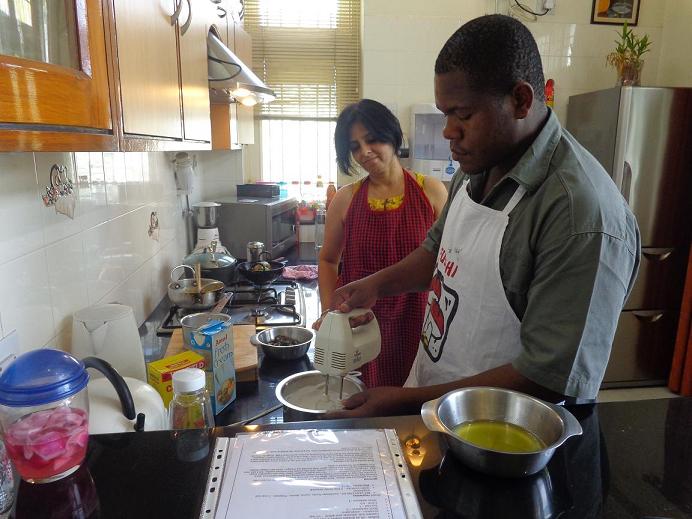
- Students and Cooking Instructor |
|
|
|
|
|
Indian Food Cooking
Classes in Jaipur, India - Images Gallery..... |
|
There are various techniques of
Indian cooking. Some of these techniques are Baghar or Tadka
(Instant seasoning or Tempering), Balchao (Pickling), Bhunao
(Curry), Dhuanaar (Smoke Seasoning), Dum (Steaming), Handi,
Kadhai, Talna (Frying), Tandoori and Tawa. Tandoori cooking is a
north Indian specialty and is famous all over the world.
Tandoori chicken, Naan, Tandoori Roti, and Tandoori Kebabs are
some of the famous Tandoori dishes.
Indian cuisine can be divided into two main cuisines, North
Indian and South Indian Cuisine. A typical North Indian meal
consists of Chappatis, parantha or pooris (unleavened
flatbreads), dals, curries that are mild and made in ghee,
vegetables seasoned with yogurt or pomegranate powder, green
vegetables like spinach and green mustard cooked with paneer,
north Indian pickles, fresh tomato, mint, cilantro chutneys, and
yogurt raitas. North Indian desserts and sweets are made of
milk, paneer, lentil flour, and wheat flour combined with dried
nuts and garnished with a thin sheet of pure silver. Nimbu Pani
(lemon drink), and Lassi (iced buttermilk) are popular drinks in
the North. Hot and sweet cardamom milk is very common before
going to bed. North Indian Cuisine can be further divided into
different categories according to states and tastes. These
categories are Kashmiri, Punjabi, Rajasthani, Garhwal, Pahari,
Uttar Pradesh, Awadh, and Lucknow.
|
|
|
|
|
|
|
|
|
|
|
|
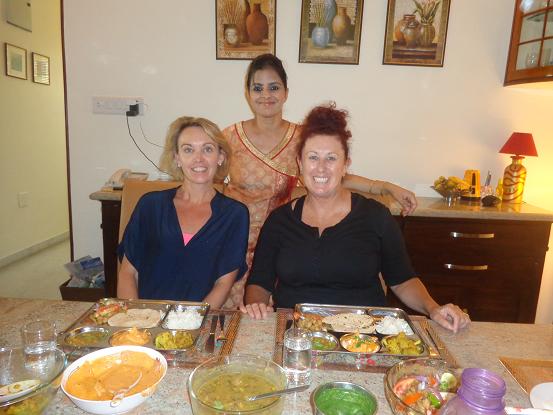
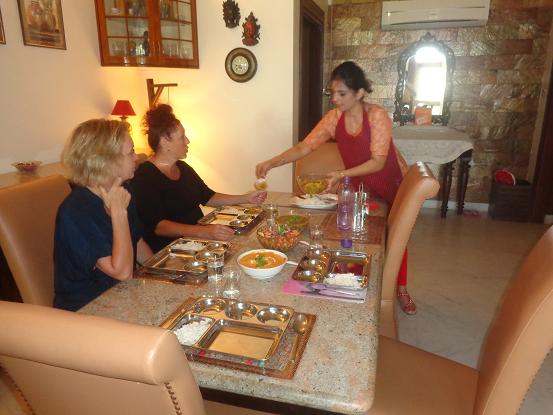
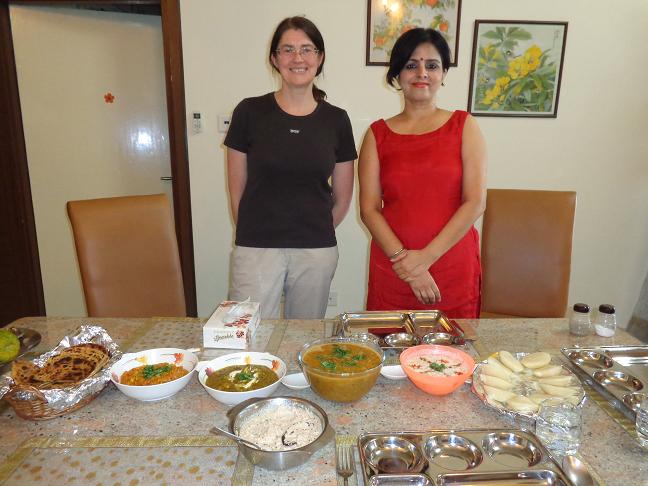
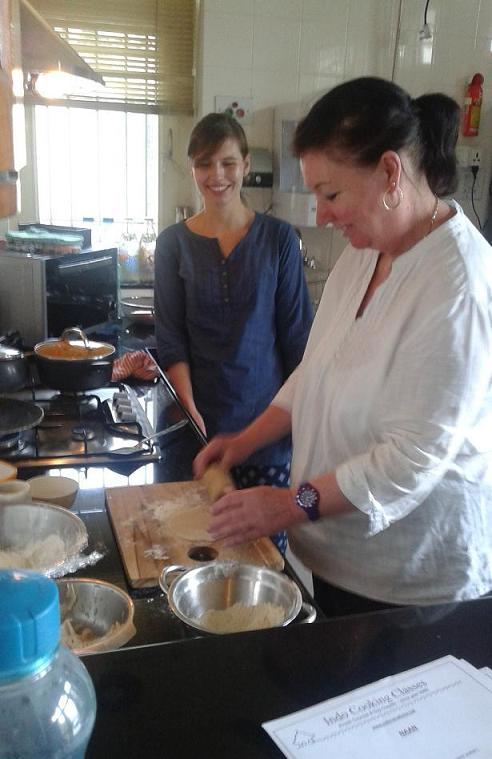
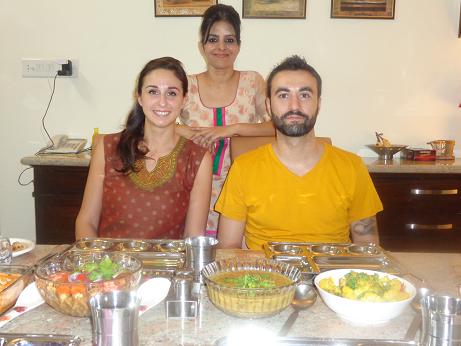
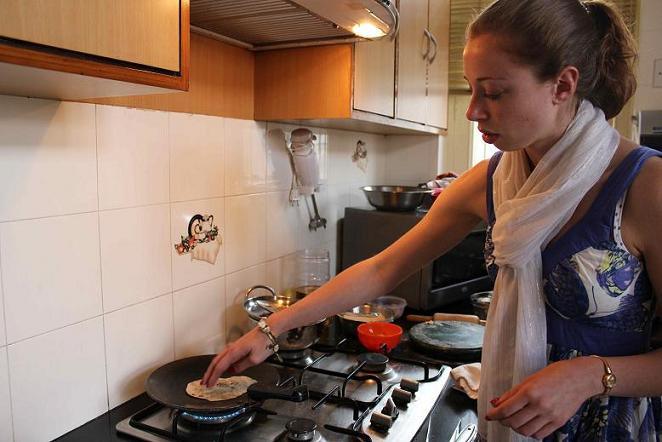
Individual
Vegetarian Cookery Classes in India
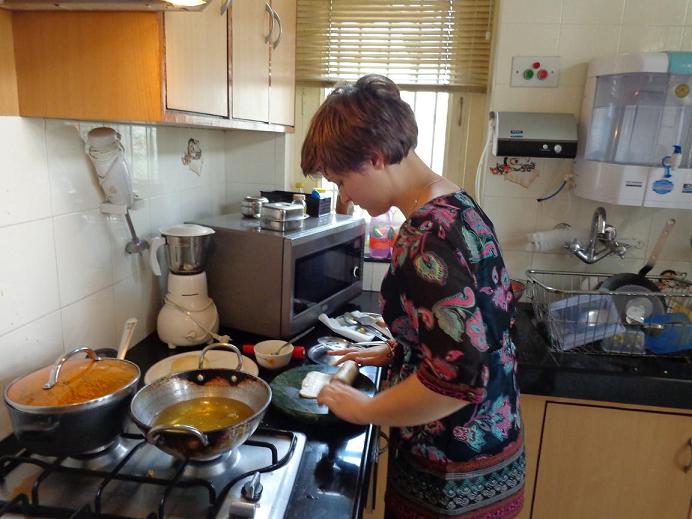
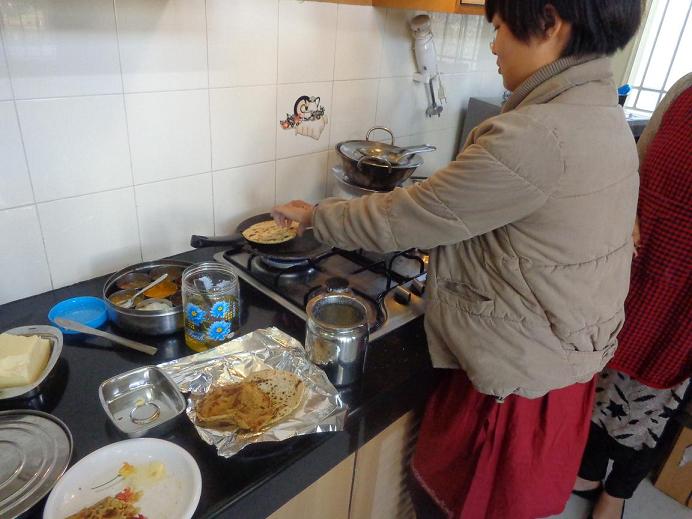
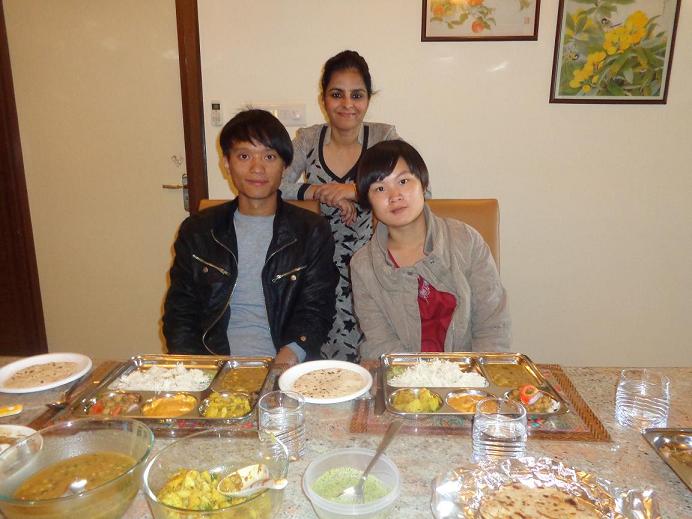
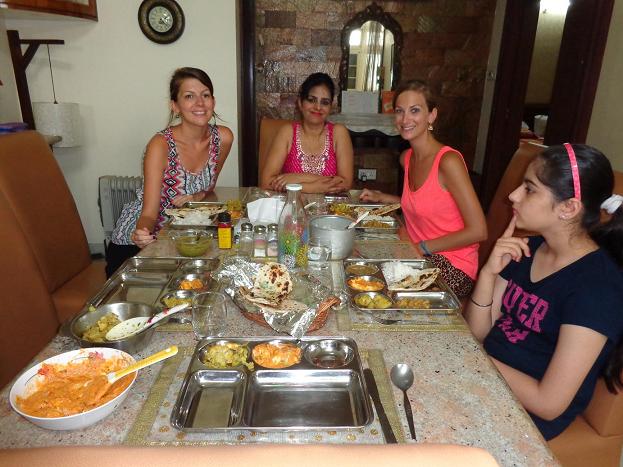
- Students and Cooking Instructor |
|
|
|
|
|
Indian Food Cooking
Classes in Jaipur, India - Images Gallery..... |
|
Medicinal value of Indian Spices |
|
|
It is quite interesting to note
that most Indian spices have a medicinal value. The most
commonly used spices and herbs in Indian cooking are asafoetida,
cardamom, clove, cinnamon, coriander, garlic, ginger, turmeric,
and aniseed. Turmeric, Ginger, and Cardamom are the most
commonly used herbs as they have digestive properties. Turmeric
gives the dish a pleasant yellow natural color and helps to
preserve the food. Coriander seeds are supposed to have a
cooling effect on the body of a person. Saffron, the most
expensive spice, creates a nice flavor and fragrance with just a
little quantity. Mustard, cinnamon, nutmeg, pepper, cloves,
poppy, and caraway seeds are some other spices used in Indian
dishes. In India, Masala is commonly used which is a blend of
various spices and it is either in a dry or a liquid paste.
Garam Masala is a blend of fragrant spices which include
cinnamon, cloves, cumin seeds, mace, coriander seeds, nutmeg,
and black pepper. It can be stored and kept for future use.
Nowadays, Garam Masalas are conveniently available in packets in
any grocery.
|
|
|
|
|
|
|
|
Indian Food Cooking
Classes in Jaipur, India - Images Gallery..... |
|
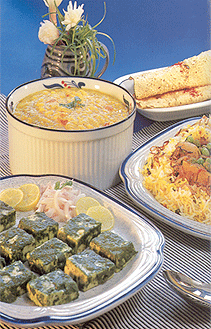
Indian dishes known as curries
|
|
|
Indian cuisine has a lot of variety to offer. Indian food can be
broadly divided into four different regions corresponding to
Delhi for the North, Bombay for the West, Madras for the South,
and Calcutta for the East. Many varieties of curry dishes are
made in different parts of India, each of which has its own
distinct flavor. For the Indians, curry encompasses a whole
class of dishes. There are numerous curries that are prepared
with meat, fish, chicken, vegetables, and on occasion, fruits.
The only common factor in all the curries is that they all
contain freshly ground spices, including turmeric, and have a
‘gravy’. The Cooking medium is pure ghee (clarified butter).
Other vegetable fats are now more commonly used as the cooking
medium.
Besides the preparation, the presentation of food is also
important to Indians. Traditionally, Indian food is served
either on a well-washed large banana leaf or in a thali which is
a large plate made of brass, steel, or silver. Porcelain plates
are also used commonly by Indian people. On the thali, several
katoris (little bowls) are placed to hold small helpings of each
dish. A typical meal may consist of a meat or fish dish, two
vegetable dishes, dal, yogurt, and a sweet dish of kheer or
halwa, pickles, chutneys, papads, etc.
|
 |
|
|
|
|
|
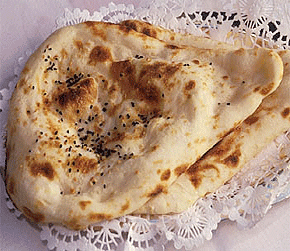
Indian Breads (Roti
- Nan - Parantha - Puri) |
|
|
|
India
offers a vast variety of bread. Unlike in the West, this bread
is the main food in the Indian meals. Chappatis and nans are
cooked in an oven or tandoor. Thin and small chappatis are made
on an iron griddle placed on gas or fire.
The most common bread
is the chappati. Basically, the chappati is just flour and water
dough rolled very thin and cooked like a pancake on slow heat.
These are hot and fresh. Some breeds like puris are fried in
deep fat and paranthas are pan-fried with a little fat,
preferably ghee. These are quite soft and delicious. Indians
also make paranthas stuffed with potatoes or other vegetables
which are complete meals and are eaten along with plain yogurt
and pickle.
Puris are made from the same basic dough rolled out
thin and round with a wooden roller and deep-friend in clarified
butter or vegetable fat |
|
|
|
|
|
Indian Food Cooking
Classes in Jaipur, India - Images Gallery..... |
|
|
Bread is more commonly
eaten than rice. The omnipresent chappati is the
common man’s dish. Nan is a kind of luxury and is
preferred eaten with tandoori food. Another variety of
rich bread is parantha which is prepared of wheat
flour and is relished by almost everyone. Since most
Indian restaurants abroad serve Tandoori food, the
foreigners are more familiar with it. Tandoori chicken
or mutton is a barbecued food that is spiced and
marinated in yogurt. Tandoori chicken with a nan,
green salad, and a dessert is a dish that the tourists
cannot resist. Tandoori food is not very spicy and is
very similar to western cooking. In Delhi, many
varieties of meat kababs are available like the Boti
Kabab, Reshmi Kabab, and Pasinda Kabab. The other
delicacies of Northern Indian cuisine are biryani
which is a dish made of rice, saffron, and marinated
lamb or chicken. Pulao is a slightly less complicated
version of biryani. There is another exciting version
– sweet pulao made with rice, coconut, almonds,
mangoes, and papayas.
|
|
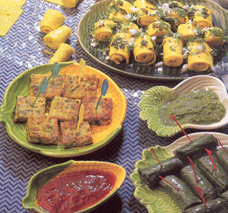 |
Besides
tandoori food, the other choices available
are Rogan Josh, lamb curry, Kofta, Korma,
or Do-Piaza. Do Piaza is made with lots of
onions, Korma is particularly rich and
Koftas are curry along with small balls of
meat. The large Koftas have a stuffing of
boiled eggs. North Indian meal is also
accompanied by dal (lentil soup).
For the
vegetarian lovers, this cuisine offers
several dishes like Panner, Sag Paneer
(cheese with spinach), Bharta, a delicious
vegetable made from eggplant, and several
other dishes combining cauliflower,
potatoes, and other similar vegetables.
The dessert mainly includes kheer, firni
(pudding), or halwa.
Since Kashmiri food
has also been influenced by Mughlai food,
so there are many varieties of meat
dishes, especially lamb dishes, and are
spicier as compared to other typical North
Indian dishes...
|
|
|
|
|
|
|
|
|
|
UP
|
|
|
|
The
most famous form of Kashmiri cuisine is Wazwan. Wazwan is the traditional
24-course banquet with many ways of cooking and varieties of meat - some in
curry, some dry, and of various sizes. These are carefully cooked by the
master chef, Vasta Waza, and his retinue of wazas. The meal is served on a
large metal plate called the trami. The rice is served in a mound in the
center. There is an earthen pot which is filled with freshly made yogurt and
chutney. The meal began with a ritual washing of hands at a basin called the
tash-t-nari, which is taken around by attendants. Seven dishes are a must
for these occasions which are Rista, Rogan Josh, Tabak Maaz, Daniwal Korma,
Aab Gosht, Marchwangan Korma, and Gushtaba.
|
|
|
|
|
|
|
|
The
most famous dish of Punjab is the Sarson ka saag, which originated from
Punjab. This dish of green mustard is simmered and slow-cooked over coals
along with rajma, kali dal, or lentils. This dish is served with the
unleavened bread of cornmeal or wheat and a dollop of butter or with steamed
basmati rice.
|
|
|
|
|
|
|
|
The
major ingredient of the Rajasthani or Marwari dishes is the Gram flour or
Besan. The gram flour is used to make some delicacies like Khata, Gatte Ki
Sabzi, and Pakodi. Powdered lentils are used for Mangodi and Papad. Bajra
and corn are used all over the state in the preparation of Rabdi, Khichdi,
and Rotis. Some of the famous sweets and desserts of Rajasthan are Laddoos,
Malpuas, Jalebies, Rasgullas, Mishri Mawa, Mawa Kachori, and Sohan Halwa,
and Mawa or milk cake.
|
|
|
|
|
|
|
|
Most families in Uttar Pradesh eat vegetarian food. The most famous sweets which are found in the cities of Uttar Pradesh are jalebies, sweetmeats, variety of 'kachoris' and pethas.
The Awadh style of cooking is famous all over the world for its tender meat dishes and excellent sweets.
Lucknow is known all over the India for its biryanis and different meat preparations. Nihari and
naan, a mutton dish served for breakfast is one of the dishes
that should be tasted to be believed.
|
|
|
|
|
|
|
|
In Bengal,
food is quite plain and rice is the staple diet. Most, Bengalis prefer
freshwater fish and fortunately, there is an abundance of it in many homes
in rural Bengal which have their own fish ponds. Mustard seeds and mustard
oil are generally used as the cooking medium for the various fish dishes.
Bekdi, a special fish of Bengal, especially lends itself to the Western
style of cooking. If Bengali’s first love is fish, then the second is
sweets. Special and typical sweets that come from Bengal are Misti Doi which
is then sweetened yogurt, Sandesh, and Rasgullas, made in different ways
from cottage cheese. Bengali cuisine is unique in India where plain yogurt
is missing from its menu. Traditionally, no sweets are made at home and are
always bought from the confectioner.
|
|
|
|
|
|
|
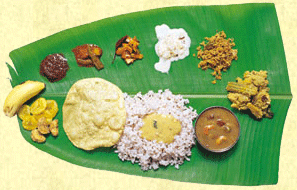 |
South Indians
eat a lot of rice and their curry is as rich
as in North India, but it is spicier. Their
vegetarian food provides a lot of variety,
especially Brahmin food which is different
from the non-Brahmin food.
Tamarind, chilies,
and coconut are grown in abundance in the
south. A typical meal in the South consists of sambhar, rasam (a thin lentil soup), and some
vegetable preparations which are often cooked
with grated coconut and yogurt and eaten with
boiled rice. Sambhar, the staple dish of South
Indians, is made with a combination of arhar,
yellow lentil, tamarind, spices, and
vegetables.However, the
most popular dishes are dosas and idlis whose
popularity spreads throughout the country. |
|
These dishes are served with Sambhar and
coconut chutney. Dosas are fried pancakes,
whereas idlis are more like steamed dumplings
and are made with a mixture of ground
fermented rice. |
|
|
|
|
UP |
|
Food Culture in West India
|
|
|
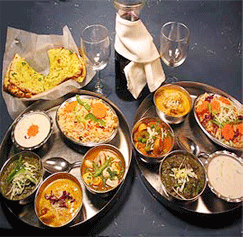
The food available in Mumbai varies from the food in the
rest of the country. This is perhaps due to the presence of
small but influential communities of Parsis, Sindhis, Goans,
and Khoja Muslims.
A few years ago, Goa was occupied by the Portuguese and hence the
Portuguese influence is present in its cuisine. One of Goa’s
best-known dishes is Vindaloo, chicken pork, or fish cooked
with spices and vinegar. Unlike other Indians, Goans eat a
lot of pork.
The fresh sausages and seafood have a special taste. The Boras and the
Khojas also have their own style of cooking. The Sindhis,
prepare a different cuisine which is more often meat-based.
The majority of Maharashtrians and Gujaratis, the original natives of this
region, are vegetarians. They have mastered the art of
vegetarian cooking.
|
 |
|
|
|
|
|
|
|
|
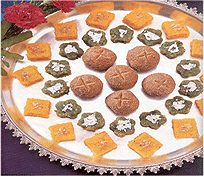
India is a country of sweets and each region of India has its
own specialties. Most Indian sweets are made by boiling down
milk to remove the moisture.
It is called khoa. When butter,
sugar, and many other flavors are added, then these take the
form of barfi, malai, kheer, rasgulla, gulabjamun and sandesh.
The various regional recipes have different forms of rice
puddings, milk puddings, vegetables and fruits dipped in sweet
syrup, etc. Combinations of all these offer hundreds of
varieties of sweet dishes. These desserts can be decorated with
raisins, almonds, pistachio, etc.
|
|
|
|
UP
|
|
|
|
Paan is generally eaten by people
after having their food. Paan is a betel leaf wrapped around a
variety of ingredients. Every paan-seller has his special recipe
to make. There are as numerous styles of preparing paan in
India. The paan made of betel leaf is the most popular and has
some digestive properties.
|
|
|
|
|
|
|
|
|
|
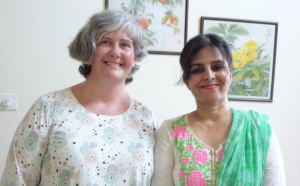
Tripadvisor Indian Cooking Classes in India
Reviews |
|
“Wonderful cooking class in indian cuisine”
 Reviewed 17 March 2015
We booked a 3 day cooking class with Suman and it was the
highlight of our 2 weeks vacation to India.
We learnt a lot about indian dishes, spices and prepared
delicious vegetarian dishes.
Suman showed us how to prepare delicious indian dishes and many
kinds of breads.
I can highly recommend her cooking class- it was a truly unique
experience.
All the dishes we prepared were delicious beyond belief.
Suman is a fantastic chef and she shared so many of her recipes
with us.
Absolutely wonderful !!!!!
Visited March 2015
NatalijaSae
“Interesting,
delicious and doable at the same time!”
Reviewed 25 February 2015
Interesting, delicious and doable at the same time! I was taught
to cook five different Indian dishes, including naan, green
chutney and Patek Paneer to Dal Makhani.
Anja K.
Visited February 2015
“Highlight of
our trip to India!”
Reviewed 22 January 2015
Don't hesitate, book this class!
My wife and I had so much fun learning to cook with Suman! Not
only is she a great cook, but she is a great teacher. She knows
how to break things down into the most simple steps. You will
come out of this class feeling comfortable making many Indian
dishes.
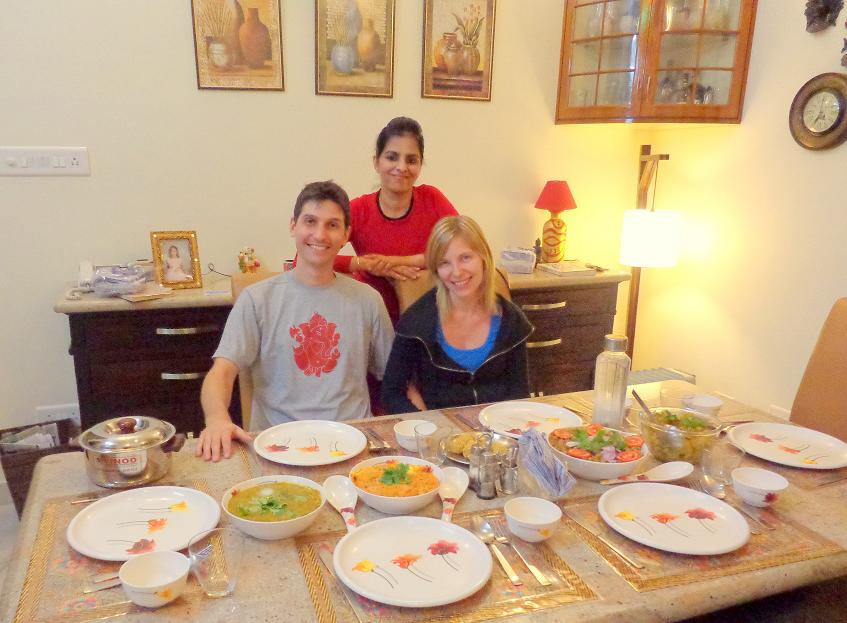
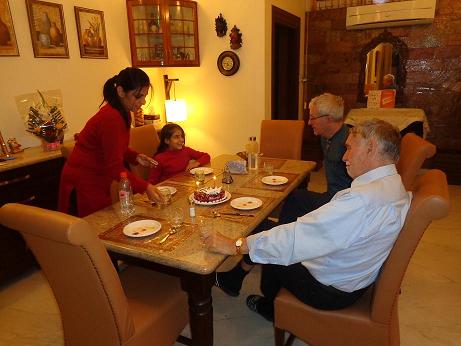
Suman has a wonderful family. We enjoyed lunch with her husband
and daughter, and had some fascinating conversation about Indian
politics.
Highly recommend!
Visited January 2015
Connor S
“We had a
great time cooking with Suman”
Reviewed 26 December 2014
It was really nice to spend some time cooking in Suman's
beautiful home. We learnt a huge range of different dishes,
including several different breads and also had a chance to
visit some of the shops where she bought ingredients. We had a
lovely lunch with her and her husband afterwards and it was by
far the best food we've had in India. A must do in Jaipur!
Visited December 2014
Becky
F
London, United Kingdom
“Fabulous
cooking class with Suman”
Reviewed 21 July 2014 |
I booked a cooking class through Indo Vacations with
Kumar's wife, Suman - what a fantastic experience! I was
warmly welcomed into Suman's home (and kitchen!). We
made 8 recipes, some recipes where the gravies can be
applied to other dishes which is great. Truly a
marvelous experience for anyone interested in cooking
and eating Indian food. DON'T MISS OUT!
For greater details about my day cooking with Suman,
check out this blog post:
http://bowen2bangladesh.wordpress.com/2014/07/19/homestyle-cooking-rajasthani-style/
Visited July 2014
Kate C
Kathmandu, Nepal |
 |
|
|
|
|
More Reviews on Trip Advisor.....
For German-speaking Travelers
information is available at:
Indisch-kochen-lernen

|
|
Indian Food Cooking Classes in Jaipur, India - Images Gallery.....
Link to YouTube
Video1
Link to
YouTube Video2
(cooking classes in Jaipur, learn cooking Indian Food,
Indian Cuisine classes, Indian Cookery demonstration
Jaipur,
Ayurveda Cooking Classes in
Jaipur,
Hands-On Cooking Classes , North
Indian Recipes, South Indian Recipes, Rajasthani
recipes, Indian Sweets,
Garam Masala secrets) |
|


 Chat
Chat


