|
|
|
Music and Dances of Rajasthan |
|
Music of Rajasthan
Music and dance play a significant role in the life of
people of Rajasthan. The cool stillness of the desert
after the hot days are filled with soulful music and
rhythmic dance. Both music as well as dance are
respected as skills by the dwellers of the desert. There
are several communities of entertainers in Rajasthan,
who served at court, recounting the tales of passion and valour of the warriors and others.
|
 |
|
|
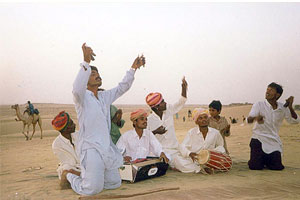
For many of
these communities, this is the only source of their income.
Traditionally, families would invite the Bhats, Dholis, Nats
and Bhaands to sing and dance at family celebrations, births
or marriages, or other festivities. No Rajasthani marriage is
complete unless accompanied by the deep bass of their voice.
Professional entertainers who performed a particular type of
dance like Bhopas, the Kachhi Ghodi dancers, and the
puppeteers are found in the more fertile tracts of eastern
Rajasthan. Some of the best known entertainers of Rajasthan
are the Kalbeliya dancers, with their rhythmic snake dances
and the Langhas and Manganiyars of Jaisalmer. The 'Dholis' or
the singing community of Rajasthan is popular both at the
domestic and international levels.
The dance styles, music and the musical
instruments also differs from region to region. The most
significant are the devotional songs and the communities who
render these songs. There is a richness and diversity in
Rajasthani music which comes from a tradition that is old and
undisturbed, and from a culture that has imbibed the best from
its neighboring states of Sindh, Gujarat, Malwa, Mewat,
Haryana and Punjab. The voices, both male and female, are
strong and powerful. The numerous songs sung by the women
reflect the various feminine moods and strong family ties that
govern their lives. |
|
|
|
Dances
of Rajasthan
The people of Rajasthan have their own ways to celebrate
the evening in the form of folk music and dance. The
desert comes alive when the performers perform the folk
dances. The females participate equally in these
refreshing activities. The Ghoomar dance is the unique
dance form of Rajasthan that is performed in the privacy
of homes, by the women only, while all other folk dances
are either linked to a particular region, or a
particular festival. In recent years, these performances
have become more widespread, and the regional
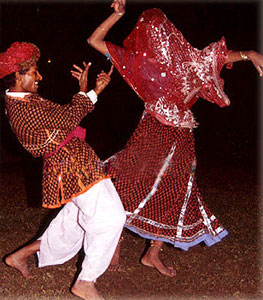
distinction is beginning to wear off. In the Ghoomar
dance, the elegant movement of the dancers in circles,
making the Ghagra (like a long skirt) flow both
clockwise and |
 |
|
|
anti
clockwise is stunning. Another dance form is the Chari dance
which involves the dancer holding a pot with lighted lamp on
their heads. It is a great art of balancing. Another act of
bravery can be enjoyed at the fire dance when the boys and men
jump over the live wood and charcoal, and the drumbeats in the
background add to the effect of the performance.
Folk Dances of Rajasthan
Some of the best known folk dances of Rajasthan are Bhavai,
Chari, Drum Dance, Fire Dance, Gair, Ghoomar, Kachhi Ghodi,
Kathak, Kathputli, Sapera Dance and Terah Tali.
Ghoomar
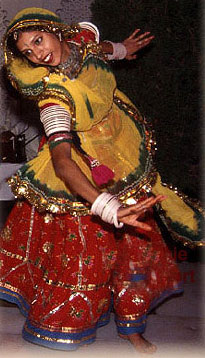
Ghoomar is a community dance form of the Rajputs and performed
by the women of the house. The word "Ghoomar" is derived from
the word ghoomna, which means moving in circles. Ghoomar is a
very simple dance in which the women uses simple swaying
movements to convey the spirit of any auspicious occasion and
move gracefully in circles. There is an amazing grace as the
skirts flare slowly while the women twirl in circles, their
faces covered by the veil. All the women, whether old or
young, participate in the dance, which can continue for hours
into the night. A new bride, on being welcomed to the home of
her husband too, is expected to do the Ghoomar dance as one of
the rituals of the marriage.
Gair
Gair is one of the dance forms of the Bhil tribes. This
picturesque dance is performed during Holi festival and
performed by both men and women together. The men wear long,
pleated tunics that open out into full-length skirts as they
move first in clockwise then in anti-clockwise direction,
beating their sticks to create the rhythms when they turn. The
variations of this dance are the Dandia Gair of the Marwar and
Geendad of the Shekhawati region. |
|
|
|
Chari Dance
Chari Dance is more popular in the Kishangarh region.
This dance involves dancing with a chari or pot on the
head. The dancers make the intricate patterns with their
hands while balancing brass pots on their heads. The
performance is made more picturesque with the flames
from cotton seeds set alight, so that the bobbing heads
create streaks of illuminated patterns as they move
effortlessly around the floor.
Kachhi Ghodi
Kachhi Ghodi dance originated from the Bandit region of
Shekhawati. This dance is performed by the men for the
entertainment in the bridegroom's party. The men wear
elaborate costumes that looks like riding on the dummy
horses. Holding naked swords, these men move
rhythmically on the beating of drums and a ballad singer
sings the exploits of the Robin Hood.
Fire
Dance
The fire dance is performed by the Jasnathis of
|
 |
|
|
Bikaner and
Churu. These dancers perform this dance on a large bed of
flaming coals on to the beats of drums that rises in crescendo
till the dancers appear to be in a near hypnotic state. These
devotional performances can be usually seen on the winter’s
night.
Bhavai
The Bhavai dance is one of the most spectacular dance. In this
dance, the veiled women dancers balance up to seven or nine
brass pitchers as they dance nimbly, pirouetting, and then
swaying with the soles of their feet perched on top of a
glass, or on the edge of a sword. Some of the performers use
only papier mache pots that are stuck together, and move their
feat, amazingly.
Drum Dance
The drum dance is performed by the warriors. In this dance, a
naked sword is put in the mouth of a man, and juggle three
swords with his hands while avoiding the injury caused to
himself. His troupe that consists of musician holding aloft
drums around their necks and cymbals in their hands assist him
in this dance.
Kathak
Kathak, a formal and classical form of dance evolved as a
Gharana in the courts of Jaipur where it reached to such a
scale that established it as distinct from the other centres.
Even today, the Jaipur Gharana is well established and the
performances occur in other centres rather than in the state
where the opportunity for classical dance forms has been on
the decline for a while. The most famous centre of Kathak in
Jaipur is the Jaipur Kathak Kendra, where this dance form is
still taught by some of the earlier teachers of the Jaipur
Gharana.
Kathputli
The traditional puppet show or Kathputli dance, once existed
in Rajasthan. Kathputli dance is a traveling form of
entertainment and uses the ballads, retold in the voice of the
puppeteer who is assisted by his family in erecting a
make-shift stage. In this dance, the puppets are strung on the
stage and various historic stories, tales of love are told and
include much screeching and high-pitched sounds as the puppets
swirl and move frenetically.
Sapera Dance
The Sapera Dance is one of the most sensuous dance forms of
Rajasthan which is performed by the Kalbeliya snake-charmers
community. In this dance, the sapera dancers wear long, black
skirts embroidered with silver ribbons. As they spin in
circle, their body swings in such a way, that it is impossible
to believe that they are made of anything other than rubber.
Sometimes, the music and dance increases to such a pitch that
it leaves the viewer and as well as the dancer exhausted.
Terah Taali
Terah Tali is the devotional form of dance that is practiced
by the Kamad community of Pokhran and Deedwana, to honour
their folk hero, Baba Ramdeo. In this dance, the women sit on
the floor before his image and thirteen cymbals are tied to
various parts of their body which they strike with the ones
they hold in their hand. Their hands make various patterns
while they do this, and sometimes, they may also balance pots
on their hands and hold a sword in their mouth. |
|
|
|
Folk
Musical Instruments
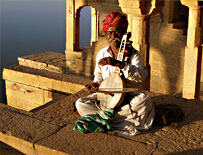
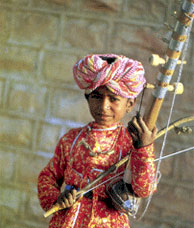
The folk singers of Rajasthan also play various musical
instruments like the sarangi, ghungroos and ektara to
bring the sweetest music to the people of Rajasthan. The
sarangi is the most important folk musical instrument
and is found in various forms in Rajasthan. The Jantar
of the Bhopas of Dev Narain ji is like the Goddess
Saraswati's Rudra Veena. The jantar has two gourds, four
strings and fourteen frets. The Ektaara is also a single
string instrument, but is mounted on the belly of a
gourd which is attached to a body made of bamboo. In
Western Rajasthan, a simple instrument called the
Morchang is very popular. The Ghoralio is common among
the Bhils, Garasiyas and the |
 |
|
|
Kallbelias. Both these
instruments resemble the Jewish harp. |
|
|
|
 |
|