|
|
|
Information about
Bastar |
|
The District Bastar is located in the southern part of Chhattisgarh and situated
at a height of 2000 ft plateau from sea level .The borders of Bastar district
are Kanker district in the north, Maharashtra State in the west , Dantewada
district in the south and Orissa State in the east. The District head quarter
Jagdalpur is situated approximately at a distance of 300 kms from Raipur, which
is the capital of Chhattisgarh state.
The beauty of Bastar district lies in its natural forest area
and various types of tribals. The total forest area is 7112 sq k.m which is more
than 75 % of the total area of the district .Of the total population more than
70 % are tribals like Gonds, Abhuj Maria, Darda Maria, Bison Horn Maria ,Munia
Doria ,Dhruva, Bhatra ,Halba etc. |
|
|
|
|
History of Bastar
|
|
The early history of the Bastar
State is obscure and it appears that the central part of the Bastar State
formed in the 11th century by the kingdom of the Nagavanshi
family who had their capital at Barsur .Their Kingdom was known as
'Chakrakot'. This Kingdom subsequently formed part of the Warangal Kingdom of the
Kakatiya dynasty.
The Bastar
Raj family claims its descent from the Pandu king ,Birbhadra of Delhi who was
granted by the family goddess Dillishwari an arrow as his weapon of war .This
Birbhadra subsequently moved to Mathura where he received a trident from the
goddess Bhuwaneshwari .Then he moved on to Jeypur (Orissa) with the family
goddess. Later on they settled at Warangal with Manikya Devi (or Danteshwari as
she is called in the Bastar inscriptions),their family goddess, who granted them
a sword when they moved into Bastar.All these weapons are still in existance and
are even now worshipped. |
|
|
|
|
Festivals & Fair
|
|
Bastar’s festivals are an exuberant showcasing of the
ancient cultural ethos of its tribal people. Mother Nature is invoked at the
turn of the seasons accompanied by singing and dancing in rituals that are
ancient as time. Danteswari is the former ruler’s reigning deity: the tribal
people worship their own gods, goddesses and spirits, inspired by nature in its
countless forms.
In much of India,
Dusshera celebrates the return of Ram to Ayodhya, but in Bastar it focuses
principally on Sri Danteshwari Mai, its primary deity. The entire festival is a
wonderful amalgam of local religious beliefs and tribal customs. Traditionally
numerous other tribal deities, man y indigenous, some borrowed from the Hindu
pantheon, congregate at her temple which is the pivotal point of the
celebrations.
Kacchhingudi, where a young girl
from the weaver community is placed upon a swing of thorns. Danteshwari
descends upon here preserving here from injury and this is considered highly
auspicious and an indication of her divine approval of the festivities.
The Saoras of Orissa build the Dusshera rath used for
transporting the deity, every year, while its construction is supervised by the
Dhakada tribe. The Khaki tribe worship the rathe before it is used
Traditionally the Parja provide the ropes that pull it. Chose members of the
Halba tribe are enthroned within the Darbar hall to mete out justice.
The Phagun Marai of Danteswara, Ramaram Mela of Sukma and
Narayanpur Marai are also some of Bstar’s colourful cultural extravaganza. Year
round you will find ancient rituals re – enacted with enthusiasm and
traditional vigour by tribal people all over the district.
Dusshera
Dusshera, Bastar’s most important festival is not about
Ram’s return to Ayodhya. The focus is principally on Sri Danteshwari Mai and
her significance in the life of this land and its people.
|
|
|
|
|
Market And
Craft |
Centuries old hallmark the simplest or the most intricate
crafts that emerge from the hands of the Bastar craftsman inspired by the world
of nature in all its effervescence. The beauty of Bastar’s crafts lies in the
delightful fusion of the antique and the contemporary.
The Harappan and Indus Valley flavour of Bastar’s
handicrafts heightens their appeal amongst the cognoscenti. Kondagaon,
Narayanpur and Jagdalpur are famous for
their terracotta crafts such as the elephant with bells and a selection of
decorative posts and tabletop items. Jagdalpur is also reputed for kosa silk weaving.
Bell metal and wrought iron work is the speciality of
Kondagaon and Jagalpur. Wood and bamboo work are best seen at Narayanpur and
Jagdalpur. Memorial stones are one Bastar’s oldest crafts.
You can pick some lovely souvenirs at the Shilpgram or Narayanpur’s
handicraft centre, where you can watch craftsmen at work popular amongst these
folk arts are elaborate wrought iron lamps and other items, wood and metal
combs embellished with images of deities, terracotta animals and figurines,
items of bell metal and hand woven textiles.
The local jail in Jagdalpur has handicrafts made by the
inmates. For true local flavour visit a colourful ‘haat’ (weekly market)
- there are about 300 of them across Bastar.
Here tribal people gather to buy salt, tobacco, cloth and other essentials in
exchange for produce collected from the forest.
Some of the finest works of Bastar crafts are showcased in
some of India’s
five star hotel lobbies and up market urban stores.
Some of Bastar’s most talented craftsmen have been acclaimed
for their participation in prestigious events such as the Festival of India
series.
Vast tracts of paddy fields, trackless vistas of virgin
forest, a dazzling range of flora and fauna, rivers, waterfalls and ancient
caves make Bastar a nature lover’s paradise and one of the finest bio – diverse
eco – travel holiday options on the planet.
This rare forest land on the peninsula is a treat for
visitors. High quality trees such as teak, sal, sirsa, tamarind, amla and mahua
distinguish the canopy of primordial forestlands. These are home to the
protected wild buffalo, tiger, leopard, macaque, crocodile, otter, civet and a
great variety of avian life such as the endangered Bastar Hill Myna.
The Kanger Valley National Park is a botanist’s
delight. There’s proposal to protect the unique eco – system of this virgin
forest as a Biosphere Reserve. The valley is also reputed for its scenic
beauty, attractive water bodies and ancient caves. For those who enjoy the
great outdoors and get a thrill out of novel adventure activities, the array of
walking and hiking trails, caving and safari opportunities have a very special
appeal.
The stalagmite and stalactite formations of Kutumsar Cave, Kailash Cave and The Dandak Cave are
popular attractions. The translucent cascades of the Tirathgarh Waterfalls from
a height of 100 ft are a great draw with picnickers and honeymooners. After
cavorting in the waterfall some devotees often head for the nearby ancient Shiv
temple, for the blessings of the deity. The exuberant Chitrakote Falls that recalls Niagara,
are created by the Indravati River.
One can combine a trip her with a visit to a Sericulture
farm and the Anthropological Museum to enjoy a slice of Bastar’s tribal culture.
|
|
|
| |
|
Riddled Of
Antiquity
|
|
The Anthropological Museum outside Jagdalpur showcases
various aspects of tribal life. Fit in a visit on your return from Chitrakote.
Tribal people comprise almost three – fourths of Bastar’s
population, each with their own indigenous culture of spirits, deities,
dialects, customs and food habits. Bastar tribal groups include Gonds, such as Marias,
Murias, Abhujmarias, Dhurwa (Parja) and Dorla, as well as non – Gond groups
like the Bhatra and Halba.
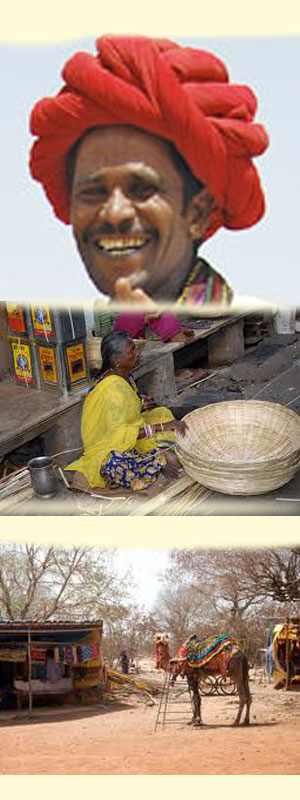
No matter where in the district you travel you cannot fail
to see those elegantly clad tribal people making their way to the local haat
(weekly market). Sure – footed, balancing their huge loads, the women walk in a
single file baskets on their heads, a child on the hip, heavily – tattooed old
ladies, brightly dressed young girls….its an evocative sight.
The Abhjmarias, an important sub caste of the Gonds, are the
shyest of the tribal people. They live in splendid isolation, hunting and
gathering produce in the deep interiors of the forests. The gregarious bison
horn headdress worn during dancing rituals. You’ll find them a popular subject
for craftsmen.
The agriculturist Muria of North Bastar
are more settled and best known for their Ghotul. This is a special place meant
for young unmarried boys and girls to meet away from adults, where they conduct
their own unique system of social education which also includes music, dancing,
story telling etc. The practice is a very important aspect of Muria society. |
|
| |
|
Verdant Odyssey
|
|
The mystical, the mythical, the historical, the natural –
You’re going to discover a whole new world out there in the vast tracts of
unpolluted, tranquil Bastar, one of the last frontiers of tribal India.
Nothing prepares you for this wonderful experience, which is just waiting for
you. Yet Bastar is not just an escape – she’s a discovery that will exhilarate
your senses, stimulate your mind and rejuvenate your body and soul
Bastar is a potent combination of antiquity and modernity,
of natural beauty and cultural diversity. She’s an enigma – a riddle waiting to
be solved. There are no pat answers – no readymade formulas to deliver to your
questing mind. Bastar makes you go that one step further to uncover her
secrets…
A cherished gem in the crown of Chhattisgarh state, she is
bordered by Orissa, Maharashtra, and Andhra Pradesh.
With almost 60% of her land under forest cover to the northwest rise the
ancient Abhujmar tribal hills and in the south lies the mineral rich Bailadila
range.
The Kanger Valley National Park’s expanse of virgin
forest, diverse flora and fauna, ancient caves, waterfalls and rivers is a
veritable paradise for botanists, adventure sports enthusiasts and artists.
Danteshwari, the tutelary deity of the Bastar royal house,
is said to have led the fleeing king to safety from invaders, into these
forested hills. Dusshera is Baster’s biggest and most important festival. But
it has nothing to do with Ram and his return to Ayodhya. It celebrates Sri
Danteshwari Mai.
And while Baster is your destiny, Raipur,
is also within easy reach of Kanha National
Park (Mukki Gate). En route enjoy a royal
experience at the palace Kawardha and visit Chhattisgarh’s own Khajuraho
temple.
Bastar – perfect for camping trips, painting holidays,
tribal tours, adventure escapes and motoring tours. Forest
the bright city lights…Come to Bastar where nature holds her own…
|
|
|
|
|
|
|
How to get here |
|
By Rail:
There is only a limited railway facility
available at Jagdalpur . The one and only railway line start from
Kinadul (Dantewada Dist.) to Vishakhapatam which passes through Jagdalpur.
This railway line is broad gauge and completely electrified. The approximate
distance to be covered by the train to reach Vishakapatnam from Jagdalpur is
320 k.m.
By Road:
Jagdalpur , the district head
quarters of Bastar district is well connected by roads to all important cities
and towns of the state and near by states also. It is connected to the state
capital , Raipur in the north by the National Highway ( NH - 49 ) and the
distance is approximately 300 k.m .The same NH - 49 extends up to
Vishakhapatnam in the east, the famous port city of Andhra Pradesh and the
distance from Jagdalpur is 300 k.m approx. Jagdalpur is also connected by state
highways to the following major towns/cities of the state and neighbour states .
|
|
|





 Chat
Chat


