|
Khajuraho - Khajuraho Temples |
|
Information on Khajuraho |
 |
Khajuraho is
situated in the state of Madhya Pradesh, the heart of Central
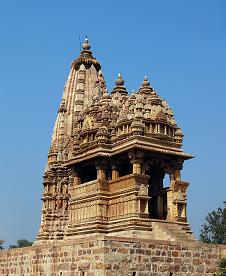
India. Khajuraho is a fascinating village with a quaint rural ambience and a rich cultural heritage. Khajuraho or 'Khajur-vahika' (bearer of date palms), also known as 'Khajjurpura' in ancient times, evidently derives its name from the golden date palms (khajur) that adorned its city gates. Khajuraho was the capital of the Chandela dynasty. The Chandela Kings claimed descent from the moon. Khajuraho is famous all over the world due to its temples. The temples of Khajuraho are among the finest examples of temple craftsmanship in the whole of India. It is the most frequently visited place in India after Agra. In
summers, the
maximum temperature is around 47 degree Celsius and in winters it is around 4 degree Celsius
minimum. Hindi and English are the common languages which are spoken in Khajuraho. The best season to visit Khajuraho
is from October to March
|
|
|
|
History of Khajuraho |
|
Khajuraho was the capital of the Chandela dynasty. The Chandela Kings claimed descent from the
Chandra, the moon god. According to a legend,
Hemvati, the beautiful daughter of a Brahmin priest of Varanasi was seduced by the Moon God while she was bathing. The child born of this union was a son,
Chandravarman. Condemned by society, the unwed mother took refuge in the forest. The boy grew up to found the Chandela dynasty. He dreamt that his mother wanted him to build temples to reveal human passions. Chandravarman began the construction of the first of the temples and successive rulers added to the complex. For many centuries after the Chandela dynasty's decline in the 13th century, the temples were concealed by dense jungles. Khajuraho was rediscovered by Captain
T.S. Burt, British army engineer, in 1838. Khajuraho was opened to tourists only a few decades ago. |
|
|
|
|
Tourist Attraction in Khajuraho |
|
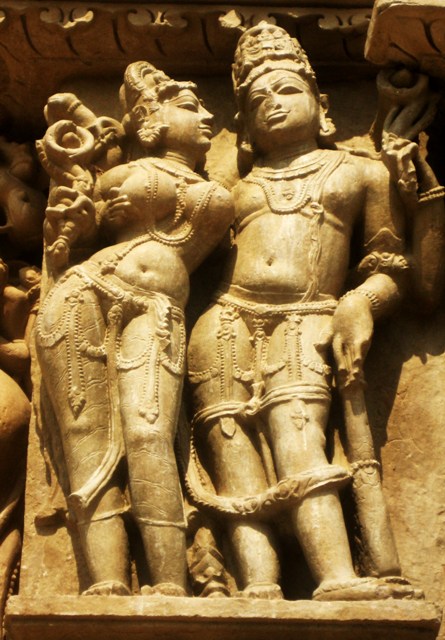
The main tourist attraction in Khajuraho are its temples. These temples are among the finest examples of temple craftsmanship in the whole of India. These temples are India's unique gift to the world. These temples are a collective salute to life, joy and creativity. The erotic sculptures in the temples of Khajuraho display different aspects of Hinduism. The temples are divided into three geographical groups namely, Western, Eastern and Southern. In the Western Group, there are various temples like Kandariya Mahadeo Temple, Chaunsat Yogini Temple, Devi Jagdambe Temple, Chitragupta Temple, Vishwanath Temple, Nandi Temple, Lakshmana Temple, Varaha Temple, Matangeswara Temple. Hindu and Jain temples make up the eastern group, close to Khajuraho village. The largest Jain temple,
Parsvanath, belong to this group. Other temples are the Ghantai Temple, Adinath Temple, Brahma, Vamana and Javari temples. Five km from Khajuraho village is the Southern group. Chaturbhuj Temple and Duladeo Temple belong to this group of temples. |
 |
|
|
|
How to get Here |
|
By Air:
Khajuraho is well connected to various cities of India. The airport is about 5 kms from the village
centre. Indian Airlines daily operate flight from Delhi to Khajuraho via Agra.
By Rail:
Jhansi is the nearest approach to Khajuraho on the main Delhi to Mumbai railway line. There is no direct route that connects Varanasi to
Khajuraho. Satna (about four hours from Khajuraho) is the nearest connecting station. On the Mumbai to
Allahabad line there are plenty of connections.
By Road:
Khajuraho is well connected by road to the various parts of India. There are regular bus services from Agra, Gwalior and
Jhansi. |
|
|
|
|