|
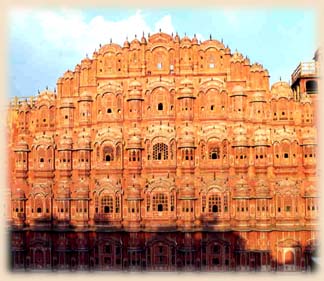
Hawa Mahal,
part of the Jaipur City Palace complex is a familiar
landmark, and is ties of pierced windows overlooking the
street below. Inside the building is only a series of
corridors with windows overlooking the street. It
overlooks one of the Jaipur's main streets and contains
953 small casements with each having its own balcony. The
windows enabled cool air to circulate and also enabled the
ladies to watch processions taking place in the bazaar and
the surrounding streets without being seen. Hawa Mahal is
a five storey, pyramid-shaped building with beehive like
structure. Each casement has tiny windows and arched roofs
with hanging cornices, exquisitely modeled and carved. Its
facade makes Hawa Mahal look more like a screen than a
palace. Its top three stories are just a single room thick
but at the base are two courtyards.
Hawa Mahal was built by red and pink sandstone, carefully
and beautifully carved and outlined with white border and
motif. Carvings and motifs designed on the walls of the
Hawa Mahal are proof of the efforts, dedication and
skillfulness of the artists of that period.
|







 Chatting


