|
Cities in Gujarat |
|
The
state of Gujarat is made up of three main areas. The eastern
region includes the major cities of Ahmedabad, Surat, and
Vadodara (Baroda). The Kathiawar peninsula, also known as
Saurashtra, is the coastal plain that is divided from the
mainland by the Gulf of Cambay. The Kutch area, separated from
Saurashtra by the Gulf of Kutch is an island, that is cut off
from the rest of Gujarat to the east and Pakistan to the north
by the low lying deserts. Some of the major cities of Gujarat
like Ahmedabad, Vadodara, Rajkot, Bhavnagar and Bhuj are
linked to Mumbai, Delhi and various other cities in India.
|
|
| |
|
Ahmedabad |
|
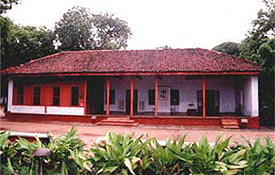
Ahmedabad, also known as Amdavad is the largest city of
Gujarat. Ahmedabad was also the former state capital of
Gujarat. This city was founded on the banks of the Sabarmati
river by the Ahmed Shah I in 1411 and known so after its name.
The various tourist attractions in Ahmedabad are the Jama
Masjid, Sidi Bashir Mosque, Sabarmati Ashram, Sidi Saiyad's
Mosque, Hathee Singh Temple and Calico Museum of Textiles.
More
Information on Ahmedabad
|
 |
|
|
|
|
Bhavnagar |
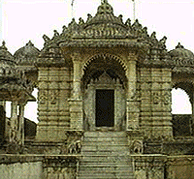 |
Bhavnagar is situated in the southeast corner of the Kathiawar
peninsula in the Saurashtra plains. Bhavnagar was founded by
Bhav Singh ji Gohil in 1723 AD near the Gulf of Khambhat, on a
carefully chosen strategic location having potential of maritime
trade. Bhavnagar grew into one of the 15th richest princely
states in India during the 20th century. Today, several lakes
and temples can be found in Bhavnagar. It is a very convenient
place to visit the Jain temples at Palitana and the Velavadar
Sanctuary. The various tourist attractions in Bhavnagar are the
Takhteshwar Temple, Gandhi Smriti, Barton museum, Victoria Park,
Takht Singh ji Hospital and Gaurishankar Lake.
More Information
on Bhavnagar
|
|
|
|
|
Bhuj |
|
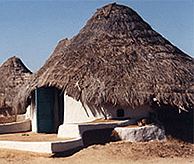
Bhuj is the most important town in the Kutch area. It was the
capital of the former native state of Kutch and now it is the
headquarters of the Kutch district. Bhuj derives its name from
the Bhujiyo Dungar, a hill, overlooking the present day Bhuj
town. This city was greatly destroyed in the earthquake in the
year 1819 and 2001. Embroidery is the most important
handicraft in this region and a paradise for handicrafts and
lifestyle lovers. The main tourist attractions in Bhuj are the
Aina Mahal, Prag Mahal and Cenotaph complex.
More Information on
Bhuj
|
 |
|
|
|
|
Daman
& Diu |
|
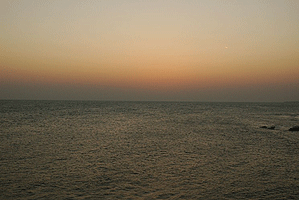
Daman
and Diu, the two small Portuguese enclaves are the union
territories which were the part of the Gujarat. Daman is a
picturesque port town hugged by the Arabian Sea and swaying
casuarines. The town is divided into two parts by the Daman
Ganga River. Diu is a tiny island in the Arabian Sea, about 11
kms. long and 3 kms. wide, separated from the coast by a narrow
channel running through the swamp. The major tourist attractions
in Diu are the Diu Fort, St. Paul's Church, Jallandhar Shrine,
Gangeshwar Temple, Diu Museum and Nagoda Beach.
More Information on
Diu
|
|
|
|
|
Dwaraka |
|
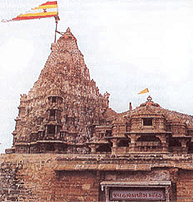
Dwaraka is located on the extreme western end of Kathiawar
peninsula, where the River Gomti meets the Arabian Sea. Dwaraka is
one of the four most important holy places of the Hindus and
attracts tourists from all over the world. The importance,
foundation, planning and glory of Dwaraka is also described in
various Hindu epics like Bhagavad Gita, Skand Purana, Vishnu
Purana and Mahabharata. According to the legends, the original
Dwaraka which was an island was submerged in the sea after the
death of Lord Krishna. Dwaraka is known for the famous Dwarkadhish
temple also known as the Jagat Mandir, dedicated to the Lord
Krishna. Besides the Dwarkadhish temple, there are various other
temples in Dwarka.
More Information on
Dwaraka
|
 |
|
|
|
|
Gondal |
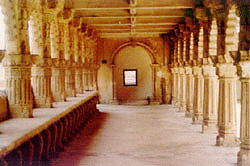 |
Gondal, a fortified town is located on the River Gondali and
was the capital of the former princely state of Gondal. In the
late 19th century and early 20th century some of the
developments were made under the rule of Maharaja Bhagwat
Sinhji in the Gondal. He introduced various social reforms and
planned the development of the Gondal town. Some of the
tourist attractions in Gondal are the Naulakha Darbargadh
palace, Riverside Palace, Orchard Palace and Royal Garages.
More Information
on Gondal
|
|
|
|
|
Junagadh |
|
Junagadh is situated in the Saurashtra region at the foothills of
the sacred hill, the Mount Girnar and occupies a special place in
the history of Gujarat. Junagadh was the capital of the Junagadh
state under the Muslim rulers of Babi Nawabs. The town of Junagadh
takes its name from the fort that enclosed the medieval town. The
most important tourist attraction in Junagadh is the remarkable
Uparkot Fort (Upper Fort). Another attraction in Junagadh are the
14 rock edicts (257- 56 BC) of the great emperor Ashoka and Mount
Girnar. Mount Girnar is one of the hills which is most sacred to
the Jain community. One of the largest and the oldest, 12th
century temple dedicated to Neminath, the Bhavnath temple and the
Ambaji temple are also situated on this hill.
More Information on
Junagadh
|
|
|
|
|
Mandvi |
|
Mandvi is located on the banks of the Rukmavati river, at the
Gulf of Kutch. This town was established in 1581 AD by the Rao
Khengarji, the first Jadeja ruler of Kutch. Mandvi was a
originally a fortified town and had a wall of about 8 m high
and 1.2 wide stone masonry. Today, Mandvi is a well known
centre for the production of the country crafts. Mandvi has
some very beautiful houses which belong to the rich merchants
with stone carving and plaster decorations. Mandvi has a very
pleasant climate throughout the year and was a summer retreat
of the Kutch Maharaos. The Vijay Vilas Palace is one of the
major tourist attraction in Mandvi. Besides this palace,
Mandvi has some very beautiful houses which belong to the rich
merchants, a girls high school, a light house and a beautiful
beach.
More Information
on Mandvi
|
|
|
|
|
Modhera |
|
Modhera
is known for the 11th century Sun temple. This temple is situated
on a knoll in the village of Modhera, about 106 kms. north west of
Ahmedabad and was built by King Bhimdev I in 1026-27 AD. The
architecture of the Modhera and the Konark sun temple is similar.
Modhera is direct connected to various cities in Gujarat. The
nearest railway station is located at Mehsana which is about 40
kms.
More Information on
Modhera
|
|
|
|
|
Palitana |
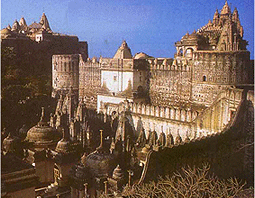 |
Palitana is one of the famous pilgrimage sites of the Jains,
located about 215 km. from Ahmedabad. One of the major tourist
attraction in Palitana are the temples located on the Shatrunjaya
hill. About 863 temples are situated on the top of the Shatrunjaya
hill. These temples are exquisitely carved in marble and built
over a period of 900 years. The Shatrunjaya hill provides a
breathtaking view of Palitana town. The temple of Shri Adishwara,
the first Jain tirthankar (apostle) and the Chaumuk or the four
faced temple, Kumar Pal, Vimal Shah and Sampriti Raj temples are
located on the Shatrunjaya hill.
More Information on
Palitana
|
|
|
|
|
Patan |
|
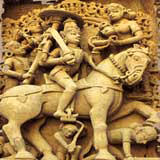
Patan,
an ancient fortified town, is situated on the banks of the sacred
Saraswati river. This town was founded by the Vanraj Chavda in 746
AD and enjoyed a privileged status of the capital of Gujarat for
about 600 years. The town of Patan was destroyed several period of
times and as such today, one can barely find the traces of such a
magnificent town. Patan is a famous manufacturing centre of the
beautiful Patola silk saris. The most significant monuments in
Patan are Rani ki Vav, Sahastralinga Talav and Khan Sarovar.
More Information on
Patan |
|
|
|
|
|
Porbandar |
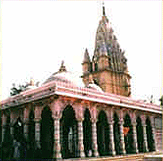 |
Porbandar, a coastal heritage town, is located on the Saurashtra
peninsula, in the Arabian Sea. This city is described in Skanda
Purana as Sudamapuri and Ashmavati and was the main link of the
great friendship between Lord Krishna and Sudama. Porbandar was
established as a capital by Rana Sartanji in 1785 AD. Porbandar is
also associated with the Mahatma Gandhi. The various tourist
attractions in Porbandar are Kirti Mandir, Darbargadh, Sudama
temple and the Huzoor Palace.
More Information
on Porbandar |
|
|
|
|
Somnath |
|
The
legendary shore temple of Somnath is located near Veraval and is
about 80 kms from Junagadh. The Somnath temple is one of the
twelve most sacred shrines dedicated to the Lord Shiva and a
jyotirlinga. According to the legends, the Somnath temple is very
old and was originally built in gold by the Somraj, the Moon God.
Later, it was rebuilt by Ravana, in silver; then by Krishna in
wood and Bhimdev in stone. Today, this majestic temple is a
replica of the earlier temple and built according to the
traditional designs by the sea. The Somnath temple was rebuilt and
destroyed seven times. This temple was finally rebuilt in 1950
with the support of Sardar Vallabh Bhai Patel.
More Information on
Somnath |
|
|
|
|
|
|
|
|
|



 Chat
Chat


