|
Guwahati - Tourist Attractions
in Guwahati |
|
Guwahati
is is commonly known as the “Gateway to the Northeast”. This
hill-ringed, green-woded, river-bordered urban centre was also known
as the Pragjyotishpura or the Light of the East, in the ancient
times and was a vast kingdom during the epic period of the
Mahabharata. The word Guwahati is made up of two words, ‘Guwa’,
which means areca nut, and ‘hatt’, which means bazaar. Today,
Guwahati is the commercial hub of the region and is known by a
moniker that emphasizes its ‘marketplace’ character. Guwahati is
also the largest city. Today, Dispur, the area in south Guwahati is
the official seat of the Assam Government. Assam as a whole is rich
in its temples. Most of the temples around Guwahati are perched on
hills or on hillsides, which afford panoramic views of the vast
Brahmaputra and as well as of the bustling city itself.
|
|
|
Tourist
Attractions in Guwahati |
|
Srimanta Sankardeva Kalakshetra
The Srimanta Sankardeva kalakshetra has been set up as a
grand exposition of the life and culture of the people
of Assam. This Kalakshetra is named after Srimanta
Sankardeva, the greatest Vaishnava saint and the
greatest integrator of the Assamese society. The
Kalakshetra is a multi-Arts complex. It houses a Central
Museum where cultural objects and day-to-day articles
used by different ethnic groups are preserved and
exhibited, an Open Air Theatre with the capacity of
about 2000 people to hold folk festivals and to present
traditional dance and drama of the State, an Artists'
Village which offers the visitors and the residents an
atmosphere of the village of Assam, the Sahitya Bhavan
which is a library of rare books and manuscripts, the
Lalit Kala Bhavan which has sufficient space for
exhibition, art and sculpture workshops, and a Heritage
Park.
|
|
|
|
Kamakhya Temple |
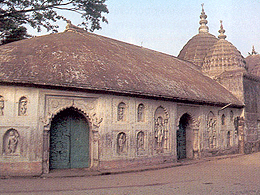 |
The Kamakhya temple is one of the busiest place in the
region. The Shakti Temple of mother Goddess Kamakhya is
situated on the top of Nilachal Hills. This place was
once a Khasi place of worship and is today, a prime
centre for Tantric practices and a very important Shakti
Peeth. The temple is also mentioned in the inscription
of the Allahabad pillar of Samudragupta. It is believed
to be the site where Sati’s reproductive organs fell,
following the destruction that took place after Daksha’s
yagna. There is no image of any deity inside the temple.
So, one has to go down into a natural cave, where a
yoni-shaped rock, washed constantly by natural spring is
the main focus. |
|
The original 9th century temple was destroyed by
invaders, but rebuilt by the Koch king Naranarayan in
1665. Architecturally, it is an interesting fusion of
styles, and the Assamese beehive dome is main part of
this temple. Every year, in the month of July, the
temple is closed for three days to worshippers, for it
is believed that Mother Kamakhya is ‘unclean’ at that
time. The Ambubachi Mela and Manasha Puja is held in the
temple and tantrics and devotees from all over the
country gather here for worship, study and deliberation.
|
|
|
|
|
Navagraha Temple |
|
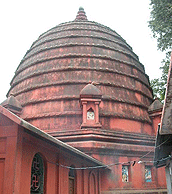
Navagraha, the temple of nine planets is situated on Chitra Chal
Hill in Guwahati. This temple belongs to the 7th century and was
a great centre of astronomy and astrology. This is also one of
the reasons why Guwahati is referred to as Pragjyotishpur or the
city of eastern Astrology. Though the frequent earthquakes in
the region have taken their toll on this temple, and the floor
plan is said to be of that period. Much of the temples as it
stands today was built by the ruler Rajeswar Singh in the late
eighteenth century.
|
 |
|
|
|
Umananda Temple |
|
Umananda, the great Shiva temple is situated on the peacock
island in the middle of the Brahmaputra river in Guwahati.
This temple attracts devotees from all over the country during
the Shivaratri festival. One can visit the temple by crossing
the river by country boat plying from Kachari ghat. On the
north bank of the Brahmaputra, there is a small place where
the third Pandava Arjun is believed to have watered his horse
while undertaking journey during Ashwamedh Yajna. Regular
ferry services are available to this place.
|
|
|
|
Basisthashram |
|
Basisthashram, a well known holy and picnic spot is situated in
the southern-most part of Guwahati on the foot hills of
Meghalaya. The great Vedic sage Bashistha, lived in the
Basisthashram. Three rivulets named Sandhya, Lalita and Kanta
meet here and flow perenially adding scenic grandeur to the
place.
|
|
|
|
|
Mahabhairab Temple |
|
Mahabhairab Temple is an ancient temple where King Bana worshipped
Mahabhairab, another incarnation of Lord Shiva. This Shiva temple
is regarded as the oldest Shiva shrine and a famous pilgrimage
place where thousands of devotees gather here during the
Shivaratri festival. |
|
|
|
|
Madan Kamdev Temple |
|
Madan Kamdev temple is only 40 kms. away from the
metropolitan city of Guwahati, on N.H. 52. This temple is
an enigma, a mystery, and a marvel. Very little is known
about the origin of this magnificient archaeological
ruins, making it a mystery. Kamrupa, the ancient name of
Assam, derived its name from the Kama or Madan god, who
was turned into ashes by the Shiva, was reborn here. Some
people believes that Madan god was reborn and united to
Rati on this tiny hillock. |
|
|
|
|
Satra |
|
The
Institution of Satra is a unique feature of Vaishnavism in Assam.
The Satras were founded by Sankardeva, the father of Assamese
culture. Satras are basically the monasteries which propogate neo
Vaishnavism. They also became centres for education and
dissemination of the art of harmonius living. In the 15th century
the first Satra was founded in Majuli. Since then sixty five
Satras have come up for the propagation of ethics and
socio-cultural ideals. At present, there are only twenty two
Satras in Majuli. The others had to be shifted to safer places due
to the devastation of flood and erosion.
|
|
| |
|
Poa-Mecca |
|
Poa-Mecca is a mosque built by Pir Giasuddin Aulia and has
one-fourth sanctity of Mecca. It is believed that by
offering prayer, the faithful gains one-fourth (poa)
spiritual enlightenment of what could be gained at Mecca. |
|
|
|
|
|
|