|
About Mizoram |
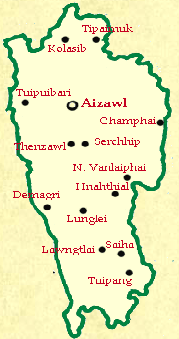 |
Mizoram, the land of the blue mountain is one of the youngest
states in the country situated in the north-eastern part of
India. Mizoram is perched like a lonely state on the
southernmost tip of the north eastern border of India. Mizoram
is bordered by Burma in the east and south, Bangladesh and
Tripura in the west and Assam and Manipur in the north.
Mizoram is mainly a Christian populated state. Mizoram
occupies an area of 21,087 square kms, and supports a
population of over five Lakh who are known as 'Mizo'. The
capital of Mizoram is Aizawl, a picturesque town built in
tiers along the hill. Aizawl is located at nearly 4,000 feet
above sea level, and a religious and cultural center of the
Mizos. The climate is not uniform in the entire state. The
valleys are warm and humid while the higher ridges are
delightfully cool and pleasant even in the hot season of the
year. The temperature ranges from 20 to 29 degree Celsius in
summer and 11 to 20 degree Celsius in winter. There is
something about the people, the blue hills rolling endlessly,
clear blue skies, the lay of the land, white painted houses
perched on bamboo sticks at the edge of steep gorge and the
temperate climate that makes every journey into Mizoram a
pleasurable experience.
|
|
|
|
|
History
of Mizoram |
|
Very little is known about the early history of Mizoram.
Between 1750 and 1850, the Mizo tribes formerly known as
Lushai migrated from the nearby Chin Hills and subjugated
the indigenous population. These tribes were assimilated
into their own society. The Mizos were the group of
tribesmen related to the Shans, who came to India. The
Mizo developed an autocratic political system based on
some 300 hereditary chieftanships. The tribes of Mizoram
remained unaffected by foreign political influence until
the British annexed Assam in 1826 under the Treaty of
Yandabo. It was not annexed until the early 1890s, and
come under British control after two decades. For the
first few years after the British annexation, Lushai hills
in the north remained under Assam while the southern half
remained under Bengal. Both these parts were later
combined in 1898 into one district called Lushai Hills
District under the Chief Commissioner of Assam. With the
implementation of the North-Eastern Reorganisation Act in
1972, the Lushai Hills District was known as Mizoram and
it became a Union Territory. Due to the historic
memorandum of settlement signed between Government of
India and the Mizo National Front in 1986, Mizoram became
the 23rd state of the Indian Union on 29th February, 1987.
The state has eight districts. |
|
|
|
|
Geography of Mizoram |
|
Evergreen forests, exotic flora and fauna, and the hilly
areas are criss-crossed by gushing rivers and their
tributaries and various silvery streams. The hills with an
average height of 900 meter, run in ridges from north to
south. These ridges vary from about 3,000 feet to 7,000
feet. The steep hills are cut apart by rivers creating
deep and narrow gorges. Besides a small portion lying in
the plains, the entire state is full of ranges running in
the north-south direction. The highest peak, the blue
mountain locally known as "Phawngpui" that means vast
meadow is about 2,065 m in height. The plains are mostly
located in the eastern part of Mizoram like Champhai
(about 7-km in length and 3-km in width) and Vanlaiphai
(about 6-km in length and 3-km in width). Through this
land mass of hills and plains flow the main 13 rivers,
which irrigate and render the soil fertile for
cultivation. |
|
| |
|
People of Mizoram |
|
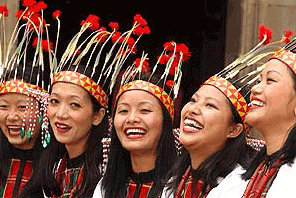
The
people of Mizoram are known as 'Mizos'. The term 'Mizo' is
made of two words, 'Mi' means man and 'Zo' means hills. Thus
Mizo means a "hill man". The Mizos are simple, happy,
carefree, contented, generous and freedom-loving people. The
Mizos are also known as the ‘Songbird of the North east'. The
Mizos enjoy a rich culture, and are passionately drawn to
dance and songs.
More Information
on People of Mizoram
|
 |
|
|
|
Dances of Mizoram |
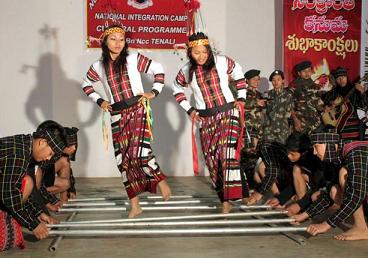 |
The
main dances of Mizoram are Cheraw, Khuallam, Chheih Hla (Chheih
lam) and Sawlakia. Cheraw is dedicated to the departed souls
of mothers who died at childbirth so that she may enter the
abode safely. In this dance, the dancers use bamboo sticks.
Khuallam is a dance which is done in the honour of visitors
and guests. Chheihlam is a dance which is done over gallons of
rice beer. Sawlakia is the traditional dance of the Mara.
More Information
on Dances of Mizoram
|
|
|
|
|
Festivals of Mizoram |
|
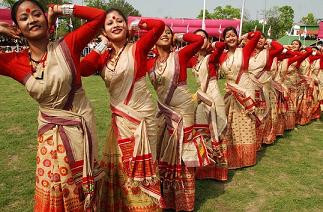
The three main festivals of Mizos are Chapchar Kut, Mini
Kut and Pawl Kut. Chapchar Kut is the greatest festival
observed after completion of the cutting down of the
jungle in February. In this festival, the Mizos dressed in
traditional Mizo costumes perform the most famous Cheraw
dance. Mini Kut is the maize festival celebrated in
September after the maize harvest is dedicated to the
departed souls. Pawl Kut is observed after the harvest in
December and devoted to children's welfare. During these
festivals, villagers sing, dance and feast in
thanksgiving. |
 |
|
|
|
|
Places
in Mizoram |
|
Aizawl, the capital of Mizoram has different places of
interest. Some of the worth visiting places in Aizawl are
Mizoram State Museum, Vantawng Water falls, Palak Lake,
Phawngui mountain, Pukzing Cave, Tamdil Lake, Dampa Sanctuary,
Champhai, Lunglei, Siaha. The Mizoram State Museum is situated
on the top of the McDonald Hill. It has an interesting
collection of historical relics, ancient costumes and
traditional implements. Durtlang is the gateway to Aizawl and
one of the highest points in town. From here one can have a
panoramic view of the city of Aizawl spread out in all its
splendour.
More Information on Places in Mizoram
|
|
|
|
|
Art & Craft of Mizoram |
|
The
Mizo art and craft items can be treasured. Mizoram has rich
and colourful range of handlooms. The Mizos are born weavers
and the intricate designs created by them are a delight.
Puandum, one of the most important handlooms of the Mizos, are
made from cotton and are handmade. Hnika, made from silk or
cotton, is also one of the finest handlooms of the Mizos.
Bamboo and cane play a vital role in their lives. Most of the
houses are made of bamboo, and various items like cane
furniture and household items are carved out of bamboo. The
main shopping attraction of Mizoram is the Khumbeu ceremonial
Bamboo hat, which is made of waterproof wild Hnathial leaves.
Bara Bazaar is the main shopping center in Aizawl. All
handicrafts and handloom items, Chinese toys, Taiwanese
electronic gadgets and Burmese fabric are available here. This
shopping area has shops on either side, and the majority of
them are run by women.
|
|
|
|
|
Wildlife Sanctuaries in Mizoram |
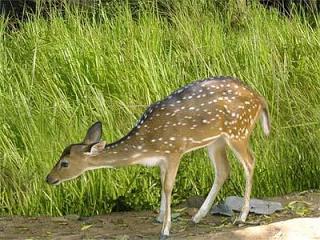 |
Mizoram, being a thickly wooded state, has a very wide range
of flora and fauna. The Himalayan Maple and bamboo are one of
the most important trees in Mizoram. It is also the home of
various rare species of orchids. Mizoram is home to a large
family of birds and animals, moths and butterflies. There are
various wildlife sanctuaries and national parks in Mizoram
like Ngengpui Wildlife Sanctuary, Lengteng Wildlife Sanctuary,
Thorangtlang Wildlife Sanctuary, Phawngpui National Park,
Murlen National Park, Tawi Wildlife Sanctuary, Palak Wildlife
Sanctuary and Dampa Wildlife Sanctuary.
More Information on Wildlife Sanctuaries in Mizoram
|
|
|
|