|
History
& Heritage
of Indian Subcontinent
|
|
Indian
Civilization is almost 5000 years
old and before that civilized communities lived in
India in planned cities with adequate arrangements. India draws
its name from
the river Indus flowing through north-west India, but is now a
part of Pakistan. The first
Aryan settlers in Indian called this great river Sindhu, which
means a large sheet of water like the sea. They built houses of
brick, wore cotton clothes, made beautiful gold and silver jewellery,
pottery and toys. Their fine seals depicted a pictographic
script which is yet not fully interpreted.
The heritage of India is the result of developments in the social, economic, cultural and political life of the Indian people over a period of thousands of
years. |
|
|
|
|
|
Two basic components of this heritage, which have at the same time shaped this heritage are the land,
the natural and physical environment of India, and
the people who have inhabited this land. The generations of people who have inhabited India during various periods of her history have interacted with
their physical and natural environment. They have also interacted among themselves. Through these
processes of interaction – between people and their
natural and physical environment and among themselves-the people have created their history, their social, economic, cultural and political life.
These processes of interaction have been going on for thousands of years, bringing in changes in the life of the people.
India is a vast country. It extends for nearly 3000 kilometers from Kashmir in the north to Kanyakumari in the south and for the same distance from
its western-most parts to its eastern-most parts. Nature has made it into a distinct geographical entity. The Himalayan ranges in the north and the sea in the
east, west and south separate it from the rest of the world. The people inhabiting the country from very early times as well as people of other parts of the
world have viewed it as a single integral and distinctive unit.
These geographical features, however, while making this country a well-defined unit separated from the rest of the world, have not become a
barrier to contacts with the rest of the world. Since the time of the Old Stone Age, people from neighboring as well as distant regions have been coming into
India through the mountain passes and the seas and making India their home. The people of India have been formed as a result of these migrations over
thousands of years. They are the descendants of groups of people belonging to almost all the ‘racial Groups’ which have gone into the making of the Indian
population are the Proto-Australoids, the Palaeo-Mediterraneans, the Caucasoids, the Negroid and the Mongoloids in their varying degrees of mixtures. In
historical times, the ethnic groups which have come to India and made India their home include the Indo-European speaking people (the Indo-Aryans), the
Persians, the Greeks, the Kushanas, the Shakas, the Hunas, the Arabs, the Turks, the Africans and the Mongols. During the past few hundred years, many
Europeans have also made India their home. All there ‘racial’ and ethnic groups have intermingled with one another and few of them can be recognized in
their original form. Thus, India has been a crucible of various ‘races’ and ethnic groups. They have all contributed to the making of Indian history and
culture.
The migration of people into India has been a major factor in the development of various aspects of India’s life and culture since pre-historic times. In
historical times, the importance of this factor is conspicuous in almost every period of India’s history. The people from other cultures and civilizations have
brought with them their own traditions, which got intermixed and integrated with the pre-existing traditions. Similarly, people of India have gone to other
parts of the world and various elements of culture carried by them have intermixed and have been integrated with the pre-existing cultures there. During the past 2000 years, the influence of various elements of Indian culture has been noticed in many countries of Asia.
The vastness of the country and the great variations in its geographical features- land forms, natural resourses, climate and others – have provided
the bases for a great variety in ways of living from very early times. The mountains and the river systems have been an important factor in the emergence of a number of distinct cultural zones within the country. The Vindhya ranges, for example, divided India into north and south with the people of the
Indo-European family of languages predominating in the northern, and those of the Dravidian family of languages in the southern parts of the country. These factors, however, have not made any part of the country isolated from the other parts. The physical barriers between different parts were not insurmountable
even in early times when means of travel were not developed. The did not prevent the movement of the people from one part of the country to
another. Despite the Vindhya ranges, for example, the movement of people from the north to the south and vice versa has been going on from very early times. Thus
while geographical factors have deeply influenced the emergence of distinctive ways of living of people in different parts of the country, the interaction
between them has been going on. The availability of different natural resources in the country has also furthered links between its diverse parts. These
factors have helped the processes of both unity and diversity. The historical development of the country has brought the people together and has led to the
growth of a common culture to which all parts of the country have contributed. At the same time, each
part of the country has developed its own distinct
identity. Because of this, the historical and cultural development of India is often described as one of unity in diversity and the culture of the country as a
whole a composite one comprising distinct parts. It has never been a monolith.
As mentioned above, people of all parts of the country have contributed to the emergence of a common culture. No particular part of region of the
country has been the main center or source of Indian culture, and different regions during different periods have played a leading role-setting new trends
and influencing developments in other parts of the country. This has been true as much of political history as of other aspects of historical development. The
first major political power arose in northern India with its center in the region around modern Patna. In the sunbsequent centuries, powerful kingdom and
empires were built in north-western India, the Deccan and the south. The Turkish Sultans and the Mughal emperors ruled over large parts of India with their
center at Delhi and, for some time, at Agra. In the eighteenth century, the Marathas, after settings up their kingdom in western India, built a vast all-India
empire. In this context, it is important to remember the concept of the chakravartin ruler which was developed in India in ancient times. This ideal
envisaged political unification of the entire country.
Another feature of India’s culture has been that it did not develop into a finished form in any period. Throughout her long history, India’s culture has been
changing and developing due to internal factors and contacts with other cultures. This process of change and development continues. The culture of India, as of any other country, is not a fixed entity. Many aspects of culture, if they retard further
progress, get discarded, others are changed, sometimes beyond
recognition; some others continue to survive and remain important, while many new elements are added.
A remarkable feature of Indian historical and cultural development has been its continuity. This
continuity has few parallels in the history of other
civilizations. For example, the cultures of some of the earliest civilizations in human history left little evidence of their influence over subsequent cultural
developments of the countries in which they had developed. In India, on the other hand, some elements
of the Harappan culture continue to exist to this
day.
It is interesting to know the story of the name of our country. The ancient Indians referred to their country as ‘Jambudvipa’ or the continent of the
Jambu tree. The ancient Persians referred to our country as the land beyond the river Sindhu (Indus). They, however, pronounced it as ‘Hindu’. The word
spread westward and the whole country came to be known by the name of its river. The Greeks called it ‘Inde’ and the Arabs ‘Hind’. In medieval times, the
country was called ‘Hindustan’ from the Persian word. The English called it ‘India’ from the Greek ‘Inde’. The present name ‘Bharat’, derived from the
ancient usage, means ‘the land of the Bharatas’, an ancient Indian tribe.
Before studying the development of a few selected aspects of India’s culture, it may be worthwhile to recapitulate broad features of Indian
historical development.
|
|
|
|
|
|
|
|
India was one of the oldest centers of the prehistoric cultures of the world. India was also the cradle of one of the earliest civilizations in history-the
Harappan culture. The Harappan culture was the first urban culture to emerge in India. Many of its features distinguished it from all its contemporary cultures in other parts of the world, and made it distinctly Indian. Larger in extent than any of its contemporary
civilizations, it was spread over parts of Baluchistan,
Sind, Punjab, Haryana, Rajasthan, western Uttar Pradesh and Gujarat and had links with some other parts of India as well as with contemporary
civilizations
in West Asia. After its decline, India did not have cities for about a thousand years.
However, all that this civilization had built was not forgotten and many of
its features became a part of the Indian culture in the subsequent years.
The next major phase in ancient Indian history is the Vedic age which began with the coming of the Indo-European speaking people (the Indo-Aryans) and
ended in about seventh century B.C. Initially, this phase marked a reversal in some respects. For example, it marked the end of city life, reversal to a pastoral economy and the predominance of a tribal system of political organization. However, with the knowledge and use of iron technology, it saw the
beginning of the spread of agriculture throughout the country. It thus laid the foundations of a civilization in all parts of the country, whereas the Harappan
culture had been confined to parts of north-western India. The culture that began to emerge during this
phase was the result of the intermixing of the
Indo-Aryans with the pre-existing inhabitants of India. It is
interesting to remember that some element of the culture of this period have survived over a
period of 3000 years and continue to be a part of Indian culture today. The next phase, covering the period from
about the sixth century B.C. to about 200
B.C., is marked by far-reaching changes in almost every aspect of life in India. This period saw the spread of agriculture over large parts of the country, the
rise of cities and the formation of states. the period also saw the rise and decline of the first all-Indiaempire in
Indian history. This period is important not
only for political unity but also for cultural unity. Two major
religions –Jainism and Buddhism – which arose in the sixth century B.C.left a lasting influenced
religious beliefs and practices which, grouped together, are known as Hinduism. Hinduism as it
developed, included many Vedic beliefs and practices but
had many other features which distinguished it from the religion of the Vedas. This period saw the spread throughout the country of beliefs and
practices
associated with Hinduism, including Vedic religion, as well as Buddhism and Jainism.
Alongside these, a large number of other beliefs and practices also
continued. The Varna system, the system of social organization popularly known as the caste system, which had arisen in the Vedic Age
now became
well-established and gradually became the dominant form of social organization throughout
the country. This form of social organization was peculiar to
India. The rise of cities, crafts and trade also furthered the process of cultural unity. This process is best exemplified by Ashoka. He unified
almost the entire
country under one empire but renounced the use of war as state policy. Instead he
declared the victory of righteousness as the real victory. In him we also
find a change in the ideal of kingship. Ashoka, in one of his edicts, said, “whatever exertions I make, I strive only to discharge the
debt that I owe to all
living creatures”. Most of his inscriptions spread over different parts of the country
are in Prakrit, which seems to have become the lingua franca of the
country, and in Brahmi script, the earliest known Indian script, and mother of Indian Scripts. However, in areas where the language and
script were different, the Ashokan edicts were inscribed in the local language and the local script.
Though he himself became a Buddhist, Ashoka made no effort to
impose it on others. In one of his edicts, he said, “One who reveres one’s own religion and disparages that of another from devotion to
one’s own religion and to glorify it over all other religions, does injure one’s own religion most certainly”.
The next phase in ancient Indian history covers the period form about 200 B.C. to about A.D. 300. This
phase is extremely important for the
changes that took place in economic and political life, and significant developments in various aspects of culture, including religion, art and science and
technology. In economic life, this period is significant for advancement in India’s international trade, both
by land and sea routes, and the emergence of
crafts and towns, unknown to earlier phases of ancient Indian history. In political life, large parts of north-western, northern and western India were ruled by
dynasties of non-Indian origin. These were the Indo-Greeks, the Shakas, the Parthians and the
Kushanas. These political contacts facilitated developments in
the economy mentioned above and brought India into close contact with the cultures of Central and West Asia and with the Graeco-Roman
world. This
interaction played an important role in the flowering of Indian culture during this phase. Most
of the foreign rulers of Indian territories adopted one or the
other Indian religions. A significant event was the growth of the Mahayana sect of Buddhism, which the Kushana ruler Kanishka patronized, and the
development of the great Buddhist art associated with it. In the Deccan and the south, a number of
states emerged, including the powerful kingdom of the
Satavahanas. These states also developed close trade relations with other parts of the world. There was significant progress of Buddhist art in the south.
India’s first contact with Christianity is believed to have taken place during this period, though it was
many centuries later that Christianity came to have a
significant following in India.
The last phase of the ancient period of Indian history starts in early fourth century A.D. and ends in
about the eighth century. The Guptas built a large kingdom during this period which remained powerful
for about a century. In the Deccan and the south, there were two major kingdoms during this
period – of the Pallavas and of the Chalukyas. In some respects, this was also a period of reversals, which
witnessed a gradual decline of towns and trade, of strong centralized states, and the beginning of the
system of land grants. These developments, according to some scholars, mark the beginning of
feudalism
in India. Some of the finest achievements in various fields of culture-art, architecture,
literature, philosophy, science, technology – can, however, be dated to
this period. Because of these achievements, this period is often described as the classical age of Indian civilization. In religion, this is a period of decline of
Buddhism and the rise of Brahmanical religion or Hinduism as we know it today. Idol worship became popular and building of temples on a large scale
started in the south and the Deccan as well as in the north. Art inspired by Buddhism also continued, particularly in sculpture and painting. Great progress
was made in literature, both religious and secular, in Sanskrit which also became the language of the courts in most parts of the country. Tamil literature
also made great progress and the Alvars and Nayanars, the Vaishnavite and Shaivite saints, made lasting contributions to it. In spite of the dominant position
of Sanskrit in most parts of the country, this period marks the beginning of many modern Indian languages as well as distinct scripts in different parts of the
country. The period is also important for some of the most significant advances in science and technology. Most of the major works in astronomy,
mathematics and medicine belong to this period.
By the time the ancient period of Indian history came to a close, India had developed a culture which was marked by features that have
characterized it ever since.
|
|
|
|
|
|
|
|
During the medieval period, some of the achievements of the ancient times were carried forward and new and magnificent structures were built on those
foundations. Many new elements appeared in Indian society which influenced the growth of various aspects of culture.
The period from the eighth to the twelfth century in political life is dominated mainly by the presence of a large number of states. The bigger ones
among them tried to establish their supremacy in northern India and the Deccan. The main contenders in this struggle for supremacy were the Pratiharas,
the Palas and the Rashtrakutas. In the south, the most powerful kingdom to emerge during this period was that of the Cholas. The Cholas brought about the
political unification of large parts of the country but the general political picture was that of fragmentation, particularly in northern India. The process of
decline in trade and of urban centers had continued. In social life, there was greater rigidification of the caste system than before. In some respects, the
period was characterized by stagnation and insularity. Seen as a whole, however, the situation was not so dismal. Some of the most splendid temples in
India were built, in a variety of regional styles, during this period, both in the north and the south. The period is also important for the growth of modern
Indian languages. Architecture, sculpture, literature, and philosophy flourished under the patronage of the Chola Kings. Trade and cultural contact with the
countries of South-East Asia received an impetus in the Chola kingdom. New trends towards cultural unity also emerged during this period. One of these
trends is associated with the name of the philosopher Shankaracharya who set up his maths or monasteries in different parts of the country. The other was the beginning of the Bhakti cult throughout the country. It had originated with the Alvars and Nayanars, this cult became a major feature of the religious life
of the people in most parts of the country.
It was in this period that India’s contact with the new religion of Islam began. The contacts began late in the seventh century through the Arab
traders. Later, in early eighth century, the Arabs conquered Sind. In the tenth century, the Turks emerged as a powerful force in Central and West Asia and
carved out kingdoms for themselves. They conquered Persia but, in turn, their life was deeply influenced by the old and rich Persian culture. The Turks first
invaded India during the late tenth and early eleventh century and Punjab came under Turkish rule. Another series of Turkish invasions in the late twelfth
and early thirteenth century led to the establishment of the Sultanat of Delhi. Within a few centuries after the rise of Islam in Arabia, it became the second
most popular religion in India with followers in every part of the country.
The establishment of the Sultanat of Delhi marked the beginning of a new phase in the history of medieval India. Politically, it led to the
unification of northern India and parts of the Deccan for almost century. Its rulers, almost from the time of the establishment of the Sultanat, succeeded in
separating in from the country from which they had originally come. The Sultanat disintegrated towards the end of the fourteenth century leading to the
emergence of a number of kingdoms in different parts of the country. Some of these, for example, the Bahmani and Vijaynagar kingdoms, became very
powerful. In society, the period is important for the introduction of new elements – the Turks, the Persians, the Mongols and the Afghans, besides the Arabs
who had settled sown in some coastal regions- into India. There were important changes in economic life also. Trade and crafts received a stimulus and
many new towns arose as centers of administrations, trade and crafts. New elements of technology were also introduced during this period.
Culturally, this period marks the beginning of a new stage in the growth of India’s composite culture. It saw the introduction of new features in art
and architecture of India and their diffusion to all parts of the country. The architecture that developed during this period was the result of the synthesis of the traditions of Central Asia and Persia with the pre-existing Indian styles. During the fifteenth and sixteenth centuries, distinctive styles of art and
architecture also developed in the regional kingdoms, which had emerged with the disintegration of the Sultanat. During this time notable advances were
made in the development of languages and literature. Modern Indian languages, which had started developing earlier, became major vehicles of literature.
These languages were enriched by the Bhakti saints and this gave the literature of these languages many common features: Two new languages – Arabic
and Pesian – became a part of India’s linguistic heritage. Of these, Arabic was mainly the language of Islamic learning. For literature and in its widespread
use, Pesian was more important. In many areas, it replaced Sanskrit as the court language and throughout the country, along with Sanskrit, it became the
language of learning. Historical writings for the first time became an important component of Indian literature. Under the influence of Persian, new forms of
literature such as the ghazal were introduced.
The period saw two great religious movements, besides the spread of a new religion. The Bhakti movement which had started many centuries
earlier, spread throughout the country. Significantly, the Bhakti movement, best represented by Kabir and Nanak, disapproved of religious
narrow-mindedness, superstitions ad observance of formal rituals. The Bhakti saints condemned caste inequalities and laid stress on human brotherhood.
The other was the Sufi movement. The Sufis, or the Muslim mystics, preached the message of love and human brotherhood. These two movements played a
leading role in combating religious exclusiveness and narrow-mindedness and in bringing the people of all communities together. Sikhism began to emerge
as a new religion based on the teachings of Guru Nanak and other saints.
The growth of a composite culture reached its highest point under the Great Mughals in the sixteenth and seventeenth centuries. The Mughals
built an empire which once again brought about the political unification of a large part of the country. Like Ashoka earlier, Akbar, the greatest of the Mughal
emperors, followed a policy of Sulh-kul (‘peace with all’). He said, “The various religious communities are Divine treasures enthused to us by God. We must
love them as such. It should be our firm faith that every religion is blessed by Him, and our earnest end avour to enjoy the bliss of the evergreen garden of
universal toleration. The Eternal King showers his favours on all men without distinction. Kings who are
‘Shadows of God’ should never give up this
principle”. Some of the finest specimens of Indian architecture and literature belong to this period. A new significant art form was painting which flourished
under the patronage of the Mughal court. Influenced by the Persian traditions, the Mughal painting
developed into a distinct Indian style. It later spread to
other parts of the country in various regional styles. Another significant development was the emergence of anew language –Urdu- which became the
lingua
franca of the people of the towns in many parts of the country.
|
|
|
|
|
|
|
|
|
The Indus Valley Civilisation
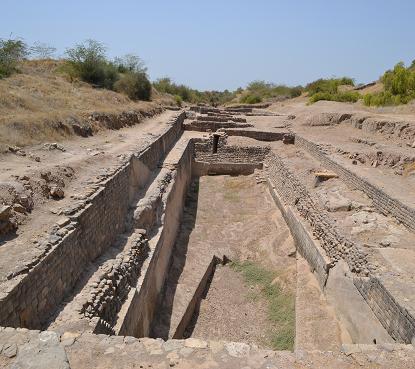
is the oldest civilization of Indian history. Its remains are found in Mohenjodaro and Harappa in Pakistan
and Kalibangan, Lothal, and Sukortada and some other cities in India. Lothal was a prosperous seaport in Gujarat. One can
see in these cities a process of continuous development in
the form of cereal cultivation, animal
husbandry, crafts, architecture and ideology.
The firmness of construction in cities
like Mohenjodaro is evident by the fact that it has survived the
damages of time for over
5,000 years. The Indus Civilisation was firmly based on a
prosperous agricultural economy. Apparently, the Indus
region had a fertile soil and bountiful rain. Apart from the Indus, the Ravi and the Saraswati rivers, the Sutlej and the Beas flowed though the fertile region of the Indus
Valley. Saraswati has since vanished due to climatic
changes. The Vedas frequently refer to Saraswati river.
|
|
|
|
|
|
|
|
The highly urbanized people of the Indus Valley disappeared from the
scene but the reasons behind this are not known yet. They were perhaps submerged by
the migration of Aryans in India during 1500 B.C.
through the mountains in the north–west. The Aryans, who were newcomers, learnt the use of
iron and tamed their horses. This knowledge gave them a superiority in Warfare over
the pre-Aryans, whom they defeated. In the course of time, a new pattern of life emerged from the
blend of the two kinds of
people.
The sports-loving Aryans developed a type of rural life which
remains unchanged even to this day. They worshipped the sun, the moon and the rivers and
composed songs in praise of them. The poems addressed to usha (dawn) are
considered some of the finest in the world’s literature. Their spiritual efforts are
preserved in the Vedas, the Upanishads and the two famous epics, the Ramayana and the Mahabharata, which
have had a powerful impact on the people of India through
the ages. Their contribution to science includes the decimal system of notation and the
concept of zero. They also developed a system of medicine and
surgery. The
Aryans were founders of the sciences of Mathematics, Astronomy and Medicine which reached the west through the Arabs.
|
|
|
|
|
|
Birth of Buddha
& Mahavira
|
|
|
With
the passage of time, many undesirable practices appeared
among the Aryan (Hindu) society. The name “Hindu” for
the people of India has come from Sindhu and was perhaps
given by the Greeks and others who followed them.
Extreme
ritualism deprived it of its earlier simplicity and the
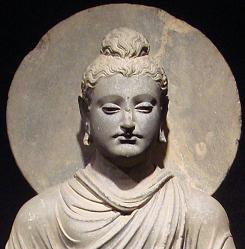
Religion became for normal people more complicated. Gautam, the Buddha, who founded Buddhism in the 6th
century B.C., and Mahavira, the first Jain Guru reformed
the religion and advised the people to lead a principled
life and follow the principles of the Golden Mean. Mahavira
laid emphasis on ahimsa (complete non violence).
Originally they did not believe in the worship of idols,
but later their followers kept the idols in their
temples.Though both the religions had their roots in India
Buddhism has been spread abroad unlike Jainism.
|
|
|
UP |
|
Arrival
of Greeks to India |
|
|
In 326 B.C., Alexander- the Great
attacked India by a large Greek army. This Greek invasion
was the West's first contact with India and it left a
lasting impact on Indian art and mythology. The Greeks borrowed a lot from Indian science, mathematics
and philosophy, which reached the other parts of Europe through them. A historian
once wrote, “Indians grow wool on trees” and he basically
referred
to cotton. Before that, the Greeks had no knowledge about cotton.
They wore animal skins to cover their bodies or cloth made
out of wool of the animals.
The first Indian empire took shape soon after Alexander left. Its founder was Chandragupta Maurya. Assisted by Chanakya, he defeated the Greek General, Seleucus Nikator and
transformed India into
a single and strong political country.
|
|
|
|
|
|
Ashoka
-
The Great Emperor |
|
|
When Ashok came to the throne in 273 B.C., his empire included almost the whole of India and Afghanistan. The
invasion of Kalinga (modern
Orissa), created a deep revolt against war and violence in
the emperor’s heart and mind. He started following Buddhism
and decided to capture men’s minds with love rather than by
sword. He wanted monolithic stone pillars to be created all
through his extensive empire. To spread the dharma, he had
them inscribed with a code of morals based on the teachings
of the Buddha. He forbade the killing of animals on certain
days of the week. This kindhearted emperor sent missionaries
to Central Asia, Burma and Sri Lanka to spread the
principles of Buddha.
|
|
|
|
|
|
|
|
With the
beginning of the Christian era commenced another fascinating age of Indian History. Merchants and adventurers left the shores of their home
land to
set up colonies in Java, Sumatra, Bali Cambodia, Thailand and Malaya. They were followed by princes, missionaries, architects and artists.
With the passage of time, the Indian colonies expanded into kingdoms and empires. The
inhabitants of these lands adopted the Indian way of life.
Indian philosophy, religion, art and architecture became an
integral part of their daily existence. From the 1st to the
middle of the 15th century, the entire South-East Asia was under Indian cultural and political influence.
|
|
|
|
|
|
The Golden age of Indian History |
|
|
The rule of the
Guptas (A.D. 320 to 495), known as the Golden Age of Indian history, was a period of
significant achievements in the field of arts,
literature and material prosperity. The finest paintings and sculptures in the caves of Ajanta and Ellora
belong to this period. Kalidasa’s Shakuntala and
Meghadoot and many others belong to this period. Aryabhatta, the
famous astronomer, argued that earth circled around the
sun. He was ignored but not killed. An iron pillar erected
at Delhi during the Gupta period still stands upright to this day without
being effected by rust. This gives
evidence of the Indians’ advanced knowledge of metallurgy. A Chinese traveller, Fa-Hien, who visited India during this period,
has given a graphic account of the peace and prosperity that
prevailed in India.
|
|
|
|
UP |
|
Impact of Islam on
Indian Society |
|
|
The next vital
period of Indian history began with the impact of Islam in the 8th
century. First came the Arabs, then the Turks and
the Afghans and, finally, the Mughals. The Mughals were great builders and
some of their well-known monuments include the Taj Mahal at Agra, the Red Fort and the Jama Masjid at Delhi
and the majestic palaces of Akbar at Fathepur Sikri. They
attained excellence in paintings,
specifically in miniatures, music, dance and poetry. But, Islam did not
upset
the continuity of Indian life. The rulers came, destroyed cities and
left.
For instance the Mughals stayed back and made India their home. They married Hindu princesses and the
Hindu princes fought for the Mughal empire. In fact, Akbar encouraged
the this for blend of Hindu and Muslim ways of life into a single national culture.
Unfortunately, his
efforts were of no use as his successors thought differently.
Aurangzeb, who had no time for finer things in life, was keen on setting up an ‘Islamic’ state in India,
which was much against the strategy of his predecessors
like Akbar and Shahjahan. For the sake of sitting on
the throne, Aurangzeb killed all his brothers and imprisoned
his father Shahjahan in the Agra Fort.
|
|
|
|
|
|
|
|
India’s
heritage in languages and literature is one of the richest
in the world. Through the many centuries of India’s history,
many languages have grown and have influenced one another.
Some of the languages that were spoken in India in ancient
times and had a rich literature have become extinct; others
remain important. For example, Sanskrit, though no longer a
spoken language, is still a language of many religious
rituals and of literature. However, the old languages have
left their mark on the languages which we speak today and
which began to develop towards the close of the ancient
period. These languages have bequeathed a very rich
literature to us.
Languages
Besides many small groups, there are two man groups of languages – the Indo-European or Indo-Aryan and the Dravidian. Most of the languages spoken in
the northern parts of India belong to the former group and those of the southern parts to the latter. However, these two groups have not developed in
isolation from each other.
The Harappan script has not yet been deciphered. We also do not know what language the Harappans spoke. Sanskrit was the language of the Indo-Aryans
who came to India and belongs to the Indo-European group of languages. Sanskrit was gradually standardized and given a highly scientific grammar by
Panini, the great grammarian, in about fourth century B.C. Sanskrit was the language of religion, philosophy and learning and was used by the upper castes,
the brahmanas and the kshatriyas. The common people spoke a number of dialects which are called Prakrits. Buddha, as you already know, preached in the
language of the people. Buddhist literature was written in Pali, one of the Prakrits. Ashoka had his rock and pillar edicts inscribed in the popular languages.
Among the Dravidian languages Tamil is the most ancient. The others developed during the first
millennium of the Christian era.
Though Sanskrit again became the predominant language of learning in the period of the Guptas, the Prakrits continued to develop. The various
spoken languages that developed are called Apabhramshas. These formed the basis of the modern Indian languages which developed in the various
regions of India during the medieval period.
During the period of the Turks and the Mughals, two new languages –Arabic and Persian – entered India. Of these Persian is more important. It
was the court language for hundreds of years and continued to be used widely right up to the nineteenth century. A rich tradition of Persian literature grew
in India during this period and led to the growth of a new language – Urdu- based on the dialects of Hindi and drawing much of its vocabulary from Persian.
It became the common language of towns all over northern India and the Deccan and developed a very rich literature in poetry and prose.
Throughout the course of the development of Indian languages, various foreign languages have played a significant part and helped Indian
languages to enrich their vocabulary. This happened as a result of close contacts with the cultures of many peoples outside India.
Thus the languages that we speak today have a long history behind them. There are eighteen languages which have been mentioned in the
Eighth Schedule of the Constitution of India. In addition to these, hundreds of other languages are spoken by people in various parts of the country. This
variety of languages has made India a multilingual country. The languages spoken today have grown over a period of centuries and have influenced and enriched one another.
|
|
|
|
|
|
Ancient Indian Literature |
|
|
The earliest known work of the Aryans in India was the Rig Veda which is a collection of 1028 hymns are in praise of different Vedic deities and were
intended for recitation at the Yajnas (sacrifices). Many of them are beautiful descriptions of nature. Some of the most enchanting are addressed to Ushas, the
goddess of dawn, like this one: In the sky’s framework she has gleamed with brightness: The goddess has cast off the robe of darkness. Rousing the world from sleep, with ruddy horses,
dawn in her well-yoked chariot is arriving.
The Rig Veda was followed by three more Vedas – Yajur Veda which gives directions for the
performance of the Yajna, the Sama Veda which
prescribes the tunes for the recitation of the hymns of the Rig Veda, and the Atharva Veda which prescribes rites and rituals. After the four Vedas, a number of works, called the Brahmanas, grew which contained detailed explanation of Vedic literature and
instructions. The Aranyakas, which are an appendix to
the Brahmanas, prescribed certain rites and also laid the basis of a body of more philosophical literature. It was the Upanishadic literature which dealt
with questions like the origin of the universe, birth and death, the material and spiritual world, nature of
knowledge and many other questions. The earliest
Upanishads are the Brihad-Aranyaka and Chanddogya. The Upanishads are in the form of dialogues and express the highest thoughts in simple
and
beautiful imagery. Another body of literature to grow in the early period was the Vedangas which,
besides rituals, were concerned with astronomy, grammar
and phonetics. One of the most outstanding works of this period was a classic on Sanskrit grammar, the Ashtadhayi by Panini.
All these works were in Sanskrit. They were handed down from generation to generation orally and were put to writing much later.
The two great epics, the Mahabharata and the Ramayana, were developed over a period of centuries and were perhaps put to writing in their
present form in the second century A.D. The Mahabharata Contains about 100,000 verses and is the longest single poem in the world. Besides the main story
of the war between the Pandavas and the Kauravas, a number of other interesting stories are woven into this epic. The Bhagvad Gita, a later addition to the
Mahabharata, enshrines a philosophical doctrine and in it are described the three paths to salvation, viz. Karma, Gyan and Bhakti. The Ramayana, the story of Rama, is shorter than the Mahabharata and is full of interesting adventure and episodes. These two epics have influenced the thinking of millions of
people for centuries.
This period abounds in both religious and secular literature in Sanskrit. The Puranas are important, for they were the main influence in the
development from early Vedic religion to Hinduism. There were many other shastras and smritis. The shastras contained works of science and philosophy.
For example, the Arthashastra by Kautilya was a treatise on the science of governance. There were shastras on art, mathematics and other sciences. The
smrities dealt with the performance of duties, customs and laws prescribed according to dharma. The most famous of these is the Manusmriti.
The early Buddhist literature was in Pali and consists of two sections. The Suttapitaka consists mainly of dialogues between the Buddha and his
followers. The Vinayapitaka is concerned mainly with the rules of the organization of the monasteries. The Milinda-panha is another great Buddhist work
consisting of dialogues between the Indo-Greek king Menander and the Buddhist philosopher Nagasena. Another great Buddhist work consists of hundreds of
Jataka stories which became the subjects of Buddhist sculpture and are popular all over the world for their wisdom. Later many Buddhist works were written
in Sanskrit. Of these the most famous is the Buddhacharita or ‘Life of Buddha’ by Ashvaghosha.
The period beginning a little before the reign of the Guptas ushered in the glorious period of Sanskrit literature, particularly secular. This was the greatest
period for the growth of poetry and drama. The great writers of this period are well known-Kalidasa, Bhavabhuti, Bharavi, Bhartrihari, Bana, Magha and many others. Of these, Kalidasa is known all over the world. His works – the Kumarasambhava, the Raghuvamsha, the Meghaduta, the
Abhijnanashakuntalam and others- are unrivalled for their poetry and style. Bana wrote the Harshacharita, a biography of King Harsha, and Kadambari.
Among the other famous works of the period are Bhavabhuti’s Utter-Ramacharita, Bharavi’s Kitarjuniya, Vishakhadatta’s Mudra Rakhshasa, Shudraka’s
Mricchakatika. Dandin wrote the Daskumaracharita or the ‘tales of the Ten Princes’. The subjects of these and other works were political events, romances, allegories, comedies and philosophical questions. Besides these, there was also a growing body of philosophical literature. The most famous of these in the
later period are the great commentaries of Shandaracharya. There were also great collections of tales and stories. The most famous collections are the
Panchatantra and the Kathasarit-sagar which have been translated into many languages all over the world.
The four Dravidian languages- Tamil, Telugu, Kannada and Malayalam – developed their own distinct sctipts and literature. Tamil is the oldest of these with
its literature going bank to the early centuries of the Christian era. According to traditions, three literary gatherings or Sangams were held at which many
sages and poets recited their compositions. This body of literature consists of many themes like politics, war and love. The famous works of this body of
literature include the Ettutogai (‘Eight Anthologies’), the Tolkappiyam (a work of Tamil grammar) and the Pattuppattu (‘the Ten Songs’). Thiruvalluvar wrote
the famous Kural which, in verse, deals with many aspects of life and religion. The Silappadikaram and the manimekalai are some of the other most famous
works of early Tamil literature.
|
|
|
|
|
|
Literature in the
Medieval Period |
|
|
In the early medieval period in northern India, Sanskrit continued to be the language of literatue. This is the period
of the works of two writers in
Kashmir-Somadeva’s Katha-sarit-sagar which we have already mentioned and Kalhana’s Rajataringing. The later, a history of Kashmir, is a work of great
importance as this is the first proper historical work in India. Another famous work of this period is the Gitagovinda by Jayadeva, which is one of the finest
poems in Sanskrit literatue. As mentioned earlier, this was the period when the Apabhramaha languages had started developing into modern Indian
languages. One of the earliest works in an early form of Hindi was Prithviaraj Raso by Chandbardai. This work which marks the beginning of bardic
literature deals with the heroic deeds of Prithviraj Chauhan.
In the southern parts, this period saw the flourishing of Sanskrit literatue. We have already mentioned the philosophical commentaries of
Shankara. Another important Sanskrit work of this period is Bilhana’s Vikramankadeva-charita, a biography of the Chalukya king Vikramaditya 6th. However,
this period is more important for the growth of literature in the Dravidian languages. Nripatunga wrote a great work of poetry in Kannada called the
Kavirajamarga. For a few centuries, the Kannada literature was deeply influenced by Jainism. Pampa wrote the Adipurana and the Vikramarjana-Vijaya, the
former dealing with the life of the first Jain tirthankara and the latter based on the Mahabharata. Poonna wrote the
Shantipurana a legendry history of the sixteenth tirthankara. Another great Kannada writer was Ranna, a contemporary of Pampa, Ponna and Ranna are known as the Three Gems of the early
Kannada literature. Kamban wrote the Ramayanam in Tamil. In Tamil, this was the period of the composition of the great hymns of the Alvars and the
Nayanars. The hymns of the Alvars are collected into the Nalayira-Divya Prabandham. Some of the Nayanar works are the Thiruvasagam, the
Thiruttondattogai. Telugu also produced great religious and secular literature in this period. This included translations of the Mahabharata and the
Ramayana, works of grammar, science and other secular literature. Literature in Malayalam also started growing.
The period of the Sultanat of Delhi saw a great advance in the growth of modern Indian languages and literature. Braj Bhasha and khari Boli,
forms of Hindi, began to be used in literary compositions. Many devotional songs were composed in these languages. Heroic literature was written in
Gujarati. The famous ballad Alha Udal and the Vishaldeo Raso belong to this period. The literature in other modern Indian languages called Chandayana.
Commentaries on ancient scriptures, however, continued to be written in Sanskrit.
Persian was the court language of the Sultanat. Because of its literature many Persian words became part of the vocabulary of Indian languages.
A very notable contribution of the Turks was in the field of historical literature in Persian. In ancient India, there was no tradition of historical writing. The
Turks introduced the Arab and Persian traditions of historical writing in India and with them we get a fairly systematic account of Indian history beginning
with the Sultanat of Delhi. There were many historians in this period. Ziauddin Barani wrote the
Tarikh-i-Firozshahi which gives a detailed account of the
reigns of the Khaljis and the Tughlaqs. He also wrote a work on political theory called the Fatawa-i-Jahandari. Perhaps the most outstanding literary
figure
of this period was Amir Khusrau. He was a poet, historian, mystic and composer of music. He
was also a disciple of Nizamuddin Auliya. He wrote the Ashiqa, the Nuh Sipihr, the Qiranal-Sadayan, the
Khazain-ul-Futuh and several works of poetry. He symbolizes the composite culture which was growing
under the
new impact. He took great pride in his being an Indian and praised India as the ‘Earthly
Paradise’. He praised India’s fauna and flora, its beauty, its buildings, its knowledge and learning. He
believed that in many respects the essence of Hinduism resembled Islam. He considered Hindawi, the
Hindi
spoken around the region of Delhi, his mother tongue and composed many verses in it. He
composed a number of bilingual quatrains and verses in Hindi and Persian. The healthy tradition started by him continued for centuries after him.
The regional kingdoms provided a great stimulus to regional languages and literature. The Sultans of Bengal, Gujarat and other states patronized
local languages and literature. Bhakti saints preached in the language of the people. Many of them like Kabir were great poets. There were two main forms
of Hindi in this period Bhojpuri and Awadhi. Kabir wrote in Bhojpuri and his dohas (Dohas are two to four line melodious verses giving a social or religious
message ) or couplets have become a part of the folklore. Malik Muhammad Jayasi wrote the Padmavat in Awadhi. The famous Ramacharitamanas by
Tulsidas was also written in Awadhi in this period. There were many other poets of Qutban, a disciple of the Sufi Saint Shaikh Burhan, wrote the Mrigavati.
Literature in other languages also developed in this period. In Bengali the Ramayana by Krittivasa and the hundreds of lyrics by the famous poet
Chandiddas were written under the patronage of the rulers. With Chaitanya, the tradition of writing devotional songs began. Narasi Mehta wrote devotional
songs in Gujarati and Namdev and Eknath in Marathi. There were important developments in Kashmir under Zainul Abidin, under whose patronage many
Sanskrit works like the mahabhatata and the Rajataringini were translated into Persian.
Under the Vijayangar Kingdom, Sanskrit literature continued to grow. However, this was an important period for the growth of Telugu literature.
Krishnadeva Raya, the greatest of Vijayanagar rulers, was also a Telugu and Sanskrit writer. He wrote the Vishnuchittiya. There were many poets in his
court, the most famous of whom was Allasani Peddana who wrote the Manucharita. Dhurjati wrote the Kalahasti Mahatamya.
As in art and architecture the Mughal period also saw great developments in literature. Many Mughal emperors and members of the royal family
were great men of letters. Babar, the first Mughal ruler, was one of the pioneers of Turkish poetry and also the author of a very valuable autobiography in
Turkish, Babar Nama which was later translated into Persian. Gulbadan Begum, sister of Humayun, wrote the Humayun Nama. Jahangir, the great
connoisseur of painting, wrote his autobiography, the Tuzuk-i-Jahangiri. Aurangzeb also was a prolific writer and the last Mughal emperor Bahadur Shah
‘Zafar’ was a notable Urdu poet.
Hindi literature made significant progress during Akbar’s reign. Tulsidas, who has already been mentioned, and the Keshavdas, a gret poet, wrote
on themes of love. Rahim’s Dohas or couplets are extremely popular in many parts of the country. It was also in Akbar’s time that the great Sanskrit work on
styles of writing, the Alankarashekhara by Keshava Misra, appeared.
This was a period of many notable writings in the Persian language. Abul Fazl wrote the Ain-i-Akbari and the Akbar Nama. Ain-i-Akbari gives
details of Indian customs and manners, religions and philosophy, economic conditions and almost every other aspect of life. As a historical work, it is
perhaps unparalleled. Abul Fazl’s brother Faizi was a great poet of Persian and was responsible for the translation of many Sanskrit works into Persian.
Akbar had started a whole department for translation of works like the Mahabharata, the Ramayana the Atharva-Veda, the Bhagvad Gita and the
Panchatantra.
Many important historical works were produced under the emperors after Akbar. Some of the most important historians of this period were Abdul
Hamid Lahori, Khafi Khan, Muhammad Kazim and Sujan rai Bhandari. Literature in modern Indian languages also continued to grow. The famous book of Bihari Lal called the Satsai in Hindi belongs to this period.
One of the most Significant developments during the medieval period was the birth of the Urdu language. This new language soon developed one
of the richest literatures as a modern Indian languages. It produced great poets like Wali, Mir Dard, Mir Taqi Mir, Nasir Akbarabadi, Asadullah Khan Ghalib
and, in the twentieth century, Iqbal and others. Urdu prose also developed early in the eighteenth century when the translation of most of the historical
works from Persian and Sanskrit into Urdu began. At the same time many original prose works in Urdu Azad’s Darbar-i-Akbari. The Urdu novel was one of
the earliest to develop in the Indian languages. Urdu became the language of the urban people of northern India and the Deccan and is one of the best
examples of the growth of a common culture.
|
|
|
|
|
|
|
|
The eighteenth century marks the beginning of the modern period of India’s history. Politically, the period
saw the decline of the Mughal empire and the rise
of a number of small and big independent states in different parts of the country. None of these states was able to replace the Mughal empire which had politically unified a large part of the country for about 150 years. In spite of this, however, the
process of the growth of composite culture continued. This is
evident from the new schools of painting which arose as a result of the influence of the Mughal painting, literature in various Indian languages,
including Urdu, and the continuing process of the coming together of people belonging to different
communities.
This period, when looked at in the context of changes taking place in some other parts of the world, is
one of stagnation. You have read before
about some of the developments that had been bringing about far-reaching changes in the social, economic, cultural and political life of Europe. Significant
advancements had taken place in the field of science, and soon new technologies were to further
transform the social, economic and political life in many
countries of Europe. The process of colonization of vast areas of the world by a few European counties had been underway since the sixteenth century.
Changes of a comparable nature failed to take place in India, as also in other countries of Asia and
Africa. There was also no awareness of the importance
of the changes taking place in Europe in spite of contacts with European traders, missionaries and others. From about the middle of the eighteenth
century,
the conquest of India by Britain began. It was completed in a few decades and by the middle of
the nineteenth century, the entire country was under the
direct or indirect rule of the British. For the first time in her history, India came under foreign rule. She was ruled by foreigners who had not come to
settle
but to rule in the interest of their mother country. A new system of exploitation of one country by
the dominant classes and groups of another country came
into being. Under the new conditions created by foreign rule, the people of India were awakened and this awakening expressed itself, finally, in the
struggle
for independence, the end of imperialist exploitation of India the early decades of the nineteenth
century, various social, religious, cultural and intellectual
movements took root which aimed at removing the state of stagnation of Indian society. These movements were influenced by the modern democratic,
humanistic and scientific though and played an important role in promoting national consciousness and
in laying the foundations of a new phase in India’s
cultural development. The nationalist movement united the Indian people on a new basis. It recognized and cherished the unity in diversity and the
composite nature of India’s culture as its unique feature. Te nurturing of this feature was an integral part of the
nationalist movement’s objective of building
an independent, united and forward-looking Indian.
|
|
|
|
|





 Chat
Chat


