|
Indian
Architecture and Sculpture |
|
Indian
Architecture is as ancient as the history of civilization. The
remains of the buildings in India belongs to the third millennium in the Indus
Valley cities. These cities are among the man’s earliest attempts to
built the urban environment. "The Great Baths of Mohenjodaro" are
some of the significant examples of architecture. Later, the
Vedic period was marked by the unspecified pastoral settlements
of mud, thatch, bamboo and timber in the valleys of Ganga and Saraswati.
Even though the examples of perishable timber structures
of that period are not available, but the facts are based on evidences left by
successive
Buddhist sculptures of the 2nd and 3rd
century BC. These sculptures depict the episodes from the life of
Buddha, in the architectural setting of the Vedic period.
The story of Indian art begins with Harappan culture. The Harappans were great builders, skilled in town planning. The houses with the various facilities, the
granaries, the Great Bath, show how skilful and efficient the people were in construction. The terracotta and stone images, the bronze figure of the dancing
girl and the artistic seals reveal the exquisite workmanship of the artists. |
|
|
|
|
|
|
The Hindu
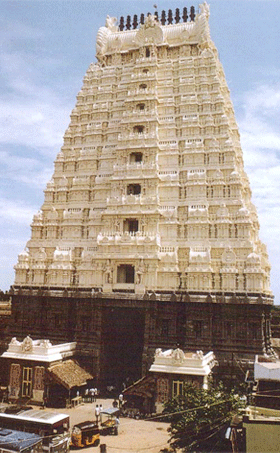
Temples are the most unique temples among the India’s prehistoric monuments.
The Indian temples were built mostly at the
places which could be approached by a large number of
people, like at
centers of pilgrimage, near a
river, lake or a man-made tank as the water was needed by
the worshippers for ablutions. The symbolic meaning can be
viewed in the architecture of the temple with its three
elements, namely, the base, the walls and the spire, which
correspond to Earth, Space and Heaven. In
other words, it represents the Feet, the Body and the Head of the Cosmic
Man. The temple is regarded as the Universe in microcosm where devotees make
offerings to the god enshrined within the temple. These
temples, either large or small, can be easily recognized by
the typical pyramidal spire, which can be easily seen in the
temples of South India. Kanchipuram, Madurai, Srirangam,
Rameshwaram are the famous pilgrimage centres in the South
India. In the North, these temples can be compared only with
the Hindu temples situated in Varanasi, one of the famous
ancient and holiest city of the Hindus. The Hindu temples were destroyed
by the Muslim invaders, and presently Varanasi has hardly any
monuments left that were built in the ancient past.
The occurrence of floods also added to the devastation. Some
of the famous temples which have survived in North India are
located in isolated places like the Khajuraho in Madhya Pradesh,
and Bhubhaneshwar and Konark in Orissa.
|
 |
|
|
|
|
|
|
|
 |
The religion Buddhism
became the principal religion of India
around the 2nd to 3rd century BC.
In this era, stone was also introduced for the first time in Indian
art and architecture. The Buddhist Stupas are supposed
to be much older than the Hindu temples. The Stupas are mound-shaped and preserve the relics either of the
Buddha or of a great figure of the Buddhist church.
Since the Stupas are identified with
the subtle body of the Buddha, so they are comparable to
a
temple. In the initial stage, the stupa evolved into an
elaborate structure with beautiful sculpture enhancing
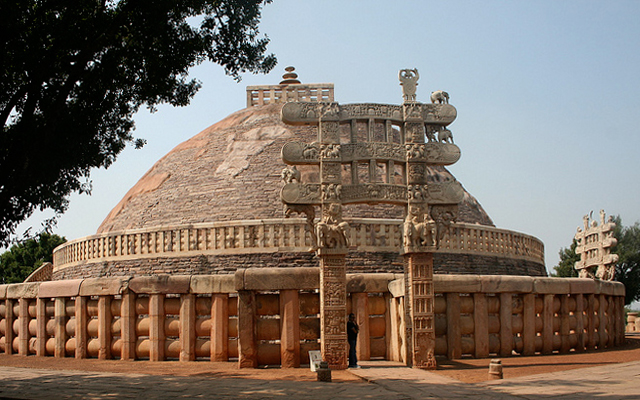
the encircling balustrades and the gateways. The Stupa
at Sanchi is one of the finest and impressive example
of the sculptures, that belongs to the 3rd century BC.
Incidents from the life of Buddha are illustrated together with the various deities of the
folk religion.
|
|
Another artistic achievement of this period is the famous stupa at Sanchi. In every stupa there was a small camber in which a casket with relics of
the Buddha or the Buddhist monks were placed. The surface of the stupa was generally built of bricks with a thick layer of plaster. The stupa was crowned
by an umbrella of stone. The monument was surrounded by a fence with a path provided for Pradakshina (circumambulation). The original stupas were
enlarged and beautified from time to time. The Sanchi stupa which still stands intact is a well-preserved and splendid monument. A number of lesser stupas
and other buildings such as monasteries and rest-houses are found in and around the main stupa.
The stupa at Sanchi as it stands today has stone railings and gateways around it. These were added later after the Mauryas. The gateways are a
very striking feature. There are four gateways at the four cardinal points and they contain very lively and beautifully carved panels. In these panels are
depicted events from the life of the Buddha and details from the Jataka stories. They also depict a landscape of trees and floral designs, groups of animals
and birds, beautiful figures of yakshas and yakshinis, and men and women. Thus the Sanchi reliefs present the story of the Buddha and provide glimpses
into Indian life through clear, simple and dramatic scenes.
The Buddha is depicted in these panels not through his image but through the use of various symbols; for example, the horse represents his
‘renunciation’, the ‘boddhi’ tree his enlightenment. |
|
|
|
|
|
|
In the field of rock-cut architecture,
the remarkable Buddhist monuments were built in the Indian
States of Bihar and Maharashtra.
The Buddhist monks enlarged and altered the caves in the hillside, and also
excavated the great and extraordinary prayer halls and monasteries out of huge cliffs.
Despite the use of the rock-cut mode, the plan and elevation of these caves
closely resemble the earlier brick and wood buildings. The monk architects
who
carved the caves introduced windows, balconies and huge arch-shaped
openings. They also added a unique distinction to the Indian traditional architecture.
The Rock - Cut Architecture is a unique addition to the
Indian art.
|
 |
|
|
|
UP |
|
|
|
The ancient remains
of the Indus valley culture discovered
in India, are those of the Mauryan period
which existed between 322-185 BC. The best specimen of the Mauryan
stone sculpture, which can be seen in many museums of
India, had a rare feeling for monumental form and royal power.
The sculpture has an exquisite finish and a brilliant
polish that has not lost its shine even after many years of
existence. Among Mauryan sculptures is the Lion Capital in the
Sarnath Museum
which has been adopted as the State seal of India. Numerous Several
Buddhist as well as Jain stupas were also built at Mathura during the rule of the
KUSHAN from 1st-2nd century. Buddhism's deep impact in the
south is evident from the remains of the
great stupas of AMRAVATI and NAGARJUNAKONDA. The
sculptor’s art is accomplished on marble in bas-relief and
holds great animation and nervous energy. The crowded scenes
depict the social life of earlier times and often relate
the inspirational tales of life of the Buddha.
The Mauryan period was a period of economic prosperity, important development in religious thinking and
practice and also one of remarkable artistic achievements. Megasthenes, who came to India as the ambassador of the Greek ruler Seleucus, described the palace of Chandragupta Maurya in glowing terms. It was large and luxurious and built of carver wood. The earliest stone buildings were based on wooden
models.
The monolithic pillars of Ashoka on which are inscribed his famous edicts are the great monuments of the Mauryan age. Some scholars trace
these pillars to the influence of Persia. The most striking feature of these pillars is the finely carved capital with magnificent animal figures. We are all
familiar with Sarnath lion capital which forms part of India’s National Emblem. The Rampurva Bull capital is one of the best specimens of animal sculpture.
The polish and smoothness of these pillars are amazing.
|
|
|
|
|
|
|
|
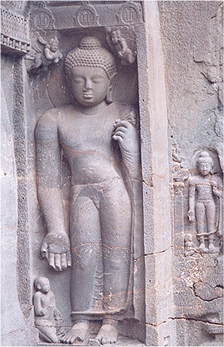 |
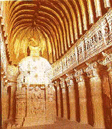
The Cave architecture expanded a lot during the Buddhist period (3rd century BC). Its finest specimens can be found in the hills of the western coast where
the quality of the rock made them suitable for excavation. The caves, mostly in groups, were independent
monastic establishment with rooms for monks to live ,and temples where the Buddha was worshipped The great cave at Karla is
probably the finest of the cave temples. Massive in size, its interior
illuminated by soft light from a large window brings in the feeling of
generosity and peace in the mind of the visitor. The sculpture, comprising human
couples, is characterized by free rhythm, grace and elegance. The Hindus developed Cave architecture in a later
period and the great cave temples at BADAMI, ELEPHANTA and ELLORA are outstanding monuments. The MAHESMURTI of ELEPHANTA near Mumbai, representing Shiva in his three aspects of
Creator, Preserver and Destroyer, has been declared by many people as the finest and extravagant single piece of Indian sculpture. The great Buddhist,
Hindu and Jain rock temples of ELLORA strive with one another in brilliance and size, and the most incredible being the KAILASH TEMPLE belonging to the
8th century. Entirely made out of a rock, it has the appearance of a small man-made mountain. |
|
|
|
UP |
|
The Golden Age of
Indian art -The Gupta Period |
|
|
The Temple
sculptures
reached near perfection in the Gupta period (AD 320-495) and
this era was known as "The
Golden Age of Indian Art". But, the temple architecture was
yet to be developed. The figures of Gods and Goddesses carved
during this period have liveliness and grace and are immersed in
spiritual feeling. In the DASAVATRA TEMPLE at Deogarh, Hindu
iconography was given a form which it possesses even to this
day. Fine images of Hindu deities as well as Buddhist and Jain
pantheons are found in the country’s museums.
|
|
|
|
|
|
Temple
Architecture (Medieval) |
|
|
The characteristic
North Indian temple with a pyramidal spire was developed in the
post-Gupta period. Architectural activity swept the
country during the 10th and 11th
centuries. Great temples were built at KHAJURAHO in Madhya
Pradesh in the 10th- 11th centuries and Bhubaneswar in Orissa
in the 8th-11th
centuries. The marble Jain temples at DILWARA, built in the 11th-13th
centuries represent a later phase of this style of
architecture. Though no single explanation of its significance is
possible, it is important to
consider that the joy of ultimate spiritual union is, in Hindu
thought, comparable to physical union. As a man embraced by his
beloved knows not of ‘I’ and ‘Thou’, so it the union of man and
God, full of joy and bliss. It has also been suggested
that some of the erotic sculptures represented the ritual aspect
of forgotten cults.
|
|
|
|
|
|
|
Temple
Architecture (South) |
|
|
|
From the 7th
century onwards there was an increase in the building of temples in South
India. The creative urge in the South lasted much longer than in
the North, where the last masterpiece was probably the KONARK
TEMPLE (13th
century). Conceived in the form of the chariot of the Sun God,
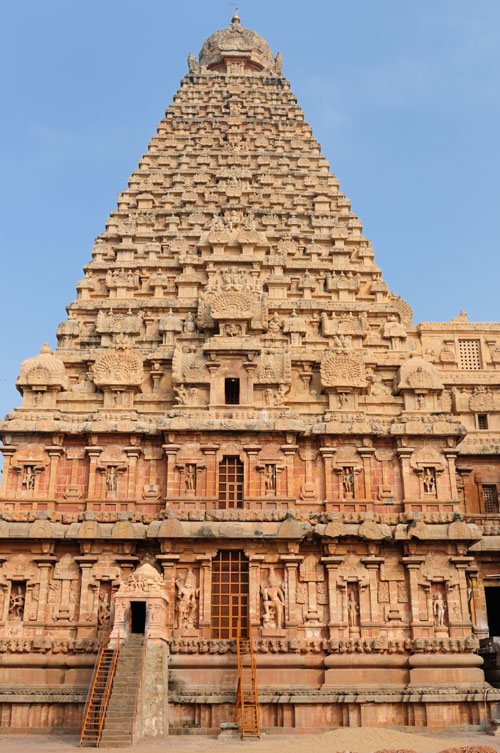
it is a striking example of Hindu architecture and sculpture. The BRIHADEESVARA
TEMPLE at Tanjore is probably the largest Indian temple
which has survived from the olden times. It was constructed
by the Chola king, RAJARAJA I. The foundations of sacred
architecture were laid during the
PALLAVA period with the construction of rock-cut temples at
MAHABALIPURAM (7th-8th centuries).
Here,
the excellent sculpture has a gentle movement and quiet dignity.
The later Pallava temples at Kanchipuram represented the same
style. Chola architecture is perceived in much more extravagant proportions. Besides the
Tanjore temple, another enormous temple was built at GANGAIKONDACHOLAPURAM by Rajaraja’s son, Rajendra
in the 11th century. The elaborately decorated medieval temples in HALEBID, BELUR and
SOMNATHPUR, presently located in KARNATAKA are quite
remarkable as they have exceptionally rich carvings made possible
by the quality of the stone.
|
|
The Pallavas built a number of structural temples also. The most famous of these is the ‘Shore temple’ at Mahabalipuram. It is located on the sea shore and
hence it has been called the ‘Shore temple’. The twin towers of this temple set in a picturesque background, make it an enchanting sight while moonlight
shining on it. Kanchipuram was the capital of the Pallavas and numerous temples were built there. Two of them stand out prominently. The Kailasanatha
temple with its lovely vimana and the numerous panels depicting Shiva as Nataraja is a fine specimen of Pallava art. The Vaikunthaperumal temple is noted for its vimana and the series of panels depicting the history of the Pallava dynasty.
The Cholas with their capital at Thanjavur were great builders. The greatest temple of India, the Birhadeeshwara temple at Thanjavur, was built
during the reign of Rajaraja Chola. The most striking feature of this temple is its vimana. It is about 65 metres high and is built in such a way that its shadow
does not fall on the ground. The grace and grandeur of the vimana have not been excelled by any other such creation. The pillared halls and the sculptures
are fine specimens of Chola art. In one of the halls, the various dance postures mentioned in Bharata’s Natyashastra are shown in sculptures. In the walls of
the inner shrine there are a number of fine paintings.
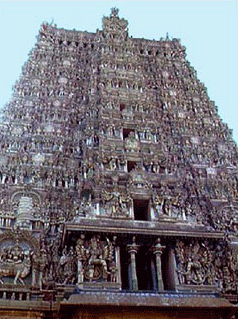
Many other famous temples were built in the south. The Pandya rulers encouraged the building of high outer walls with entrance gateways topped
by gopurams. Attention was now concentrated on the gopurams rather than the vimana or the shikahara above the main shrine. The artistic glory of the
gopuram became so popular that it became a special characteristic of south Indian temples. The gopurams of Kanchi and Madurai temples can be seen from
long distances.
The Hoysala rulers of Mysore were great patrons of art. Magnificent temple were built in Belur, Halebid and other places. These temples are noted
for the profusion of manifold pillars with rich and intricate carvings. The delicately carved friezes, the minute details of the panels depicting gods and
goddesses, are the work of the jeweler rather than of the sculptor.
|
|
|
|
|
|
Gandhara and Mathura Schools of Art |
|
|
The next important stage in the growth of art is associated with the name of Gandhara in the north-west. By this time the worship of the image of Buddha
had become common. After the Greek invasions and during the period of the Kushanas, many artists from West Asia had settled down in the north – west of India. They were deeply influenced by the Graeco-Roaman art. Mahayana Buddhism encouraged image worship. The Kushana kings, particularly
Kanishaka, encouraged the Gandhara artists to sculpture themes from Buddha’s life and the Jatakas. The distinctive school of art which grew here is called the Gandhara school of art. A large number of the images of the Buddha and the Bodhisattavas were produced.
Another school of art to develop in the early centuries of the Christian era is that of Mathura. From the beginning of the Christian era, Mathura
became an important center of artistic activities and the figures of the Buddha and the Bodhisattavas were produced there. The fine qualities of indigenous
art traditions were preserved and improved upon by the Mathura sculptors. The images produced here became the models for the succeeding generations of
artists.
This was also the period of the growth of art in developed under the Satavahana kings. Like the stupa at Sanchi, there was a great stupa in Amaravati in the
lower Godavari valley. The stupa has disappeared but many of its fine pieces are still intact in various museums. Many bas-relief medallions and paneled friezes decorated the stupa. These, like the stupa at Sanchi, depict events from the life of the Buddha and the Jataka stories. One of these depicts the story of
the taming of the elephant by the Buddha. A rogue-elephant was let loose to kill the Buddha while he was walking along the streets of Rajagriha. The panel
shows the elephant rushing through the streets, the panic it caused, the reactions of men and women and finally the elephant kneeling before the Buddha. The climax, is portrayed subtly and Pallavas of the Deccan and southern India added magnificent monuments, both caves and structural temples.
Both the rock-cut and structural monuments of the Pallavas are magnificent specimens of architecture. The Mandapas at Mahabalipuram are
excavated halls with finely carved pillars and panels.
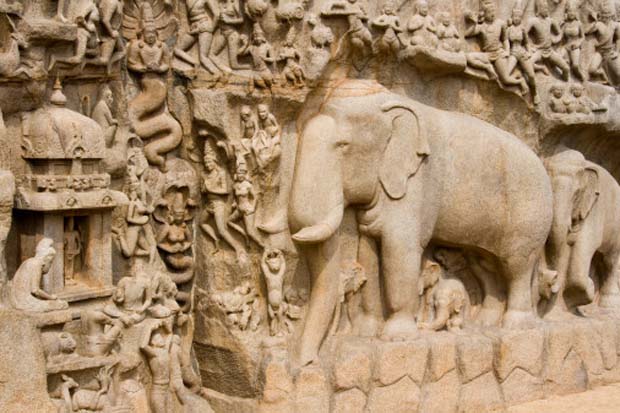
The splendid panel called the ‘Descent of the Ganga’ in Mahabalipuram is a unique rock-cut sculpture. The story of Bhagiratha’s penance to bring
down the Ganga is the theme of the panel. The Rathas of Mahabalipuram are well known. The ‘Ratha’ is a shrine carved out of a single rock and it looks like a structural temple. These
Rathas are named after the Pandavas. When you look at these Rathas, you find that each one of them is different in shape and size.
|
|
|
|
|
|
The Bronze Sculpture of the Cholas |
|
|
Starting during the late Pallava period, the bronze sculpture reached heights of glory during the Chola rule. The image of Nataraja (the Lord of Dance) is a
superb masterpiece of the Chola bronze sculpture. The grandeur of its conception, its symbolism, its artistic excellence and its charm have impressed
connoisseurs throughout the world. There are many images of Nataraja in different dance poses. The bronze sculptures were one of the most significant
contributions of the Cholas to Indian art.
|
|
|
|
|
|
|
|
As in southern India, several styles of temple architecture developed in northern India.
Some of the most magnificent temples were built in Orissa. The Lingaraja temple of Bhubaneswar is located in an extensive area, with a number
of subsidiary shrines. The spire of the Lingaraja temple is about 40 meters high and is very impressive. The immense spire is curved and has a rounded top. Though there are many similarities between these and the temples in the south, the differences in style are
striking.
The sun temple in Konarak, popularly known as the ‘black pagoda’, perhaps because of the black stone used, is unique in design. Since it is
dedicated to the sun god, the whole temple is designed as a chariot with twelve massive wheels drawn by seven horses. Each wheel with its rich carvings is
a masterpiece. The human and animal figures carved out in black stone are most lifelike. The poses of dancing apsaras depicted in sculptures are studied by
dancers even today and are brought alive by them in their performances. The theme of several of these sculptures is amorous. The Chandella rulers of
central India built the great temples of Khajuraho. The built the great temples of Khajuraho. The shikhara of these temples is graceful and refined and is
adorned with sculptures. The style of the shikhara varies from that of the others. The sculptures in Konarak and Khajuraho are some of the finest in India. They are full of life and
vitality.
The Jain temples at Mount Abu are the finest monuments of the Solanki kings of Gujarat who were great patrons of art. The prosperous trade
brought in wealth that was used for building Hindu and Jain temples. The Abu temples are very attractive because of the delicate and intricate carvings in
white marble.
The Temple
sculptures
reached near perfection in the Gupta period (AD 320-495) and
this era was known as "The
Golden Age of Indian Art". But, the temple architecture was
yet to be developed. The figures of Gods and Goddesses carved
during this period have liveliness and grace and are immersed in
spiritual feeling. In the DASAVATRA TEMPLE at Deogarh, Hindu
iconography was given a form which it possesses even to this
day. Fine images of Hindu deities as well as Buddhist and Jain
pantheons are found in the country’s museums.
|
|
|
|
|
|
New Elements in Medieval Art and Architecture |
|
|
The coming of the Turks inaugurated a new era in the history of Indian architecture, the turks brought with
them architectural ideas developed in Persia,
Arabia and Central Asia. When these new rulers started erecting religious and secular buildings such as palaces and mosques, they came into contact with the traditions that had already been developed in India. The interaction of these two traditions resulted in a new
synthesis of architectural styles. The rulers
of the Sultanat were great patrons of architecture and under them the process of synthesis started. It continued with many regional variations in the different kingdoms. During the Mughal period, the flowering of this synthesis took place and some of the greatest monuments
of India were built. Based on the
interaction of the two traditions, a unique Indian style of architecture was
developed in this period.
Before we describe this development, it may be useful to see the distinctive features of the Islamic
architecture which were to play an important
part in the development of a new style in Indian architecture.
These features are clearly seen in the standardized architecture of the mosque and the mausoleum. The
mosque consisted of a large, rectangular
open courtyard surrounded by arcades on all four sides. The mehrab which faces Mecca indicates the direction to the prayer. The call to worship was made
from a tall tower or minarets. Another characteristic feature was the arch in the gateway and other places. The dome
was another prominent feature of the
mosque and the mausoleum.
The chief decorative element was sculpturing the building with geometrical designs and lettering in
calligraphic style. Some of these features were new to
Indian architecture. The ancient Indian buildings were decorated with beautiful carving and sculpture while the Muslim buildings were marked by simplicity and lack of adornment. When the new buildings began to be erected, the two styles were
gradually synthesized into a new and unique style.
|
|
|
|
|
|
Architecture under the Sultanat |
|
|
The Turkish rulers utilized the services of the local designers and craftsmen who were among the most skilful in the world. The new fusion that started to
take place avoided the extreme simplicity of the Islamic architecture and the lavish decoration of the earlier Indian architecture.
Among the first buildings to be erected were the mosques at Delhi and Ajmer by Qutb-ud-din Aibak. The mosque built in Delhi was called the
Quwwat-ul-Islam mosque. It measured about 70 x 30 meters. The central arch of this mosque which is decorated with beautiful sculptured calligraphy still
stands and is about 17 meters high and about 7 meters wide.
The successor of Qutb-ud-din, Iltutmish, was a great builder. He further extended the mosque. He also completed the the building of the Qutb
Minar which had been started by Qutb-ud-din and now stood in the extended courtyard of the mosque. This is a tower rising to a height of about 70 metres
and is one of the most renowned monuments of India.
The next important buildings belong to the reign of Al-ud-din Khalji. He enlarged the Quwwat-ul-Islam mosque still further and built a gateway to
the enclosure of the mosque, the Alai Darwaza. Decorative element was introduced to beautify the building. He also started building a minar which was
designed to be double the height of Qutub Minar, but the project remained unfulfilled.
The Tughlaqs who came after the Khaljis concentrated on the building of new cities in Delhi like
Tughlaqabad, Jahanpanah and Feozabad. A number of buildings were erected which differed in their style from the earlier buildings. Massive and strong structures like the tomb of Ghiyasuddin Tughlaq
and the walls of Tughlaqabad were built. The buildings of the Tughlaq period were significant from the point of view of the development of architecture.
They were not beautiful but massive and very impressive.
|
|
|
|
|
|
Architecture in the Regional Kingdoms |
|
|
The regional kingdoms, building on the achievements of the previous period, developed their own distinctive styles of architecture. The process of synthesis
continued in these kingdoms also and resulted in the construction of some of the finest buildings in India.
In Bengal were built the Adina mosque and the tomb of Jalal-ud-din Muhammad Shah at Pandua and the Dakhil Darwaza and Tantipara mosque
at Gaur. The oblong shape of many structures and the peculiar style of roof constructions were some of the distinctive features of the regional architecture of
Bengal.
In Jaunpur, the Sharqi kings built an impressive monument, the Atala mosque. A huge massive screen covers the dome. The walls and the ceilings
are decorated with many ancient Indian designs like the lotus.
The rulers of Gujarat built many structures notable for their grandeur and excellence of their carving and other decorative forms. Ahmad Shah, the
founder of Ahmedabad is the Sadi Saiyyid mosque popularly known as the Jaliwali Masjid. The delicacy of the work is evident from the screens. Mahmud
Begarha built the imposing Jama Masjid at Champaner.
The buildings at Mandu developed a distinctive style of their own under the Sultans of Malwa. Here were built the Jama Masjid, the Hindola
Mahal, the Jahaz Mahal and a number of tombs. The buildings of Malwa have wide and imposing arches and the windows are gracefully decorated. The
tomb of Hoshang Shah is made entirely of marble, the first o its kind in India, and is delicately decorated with yellow and black marble inlay work.
The rulers of Kashmir also built many beautiful buildings. Timber, stone and brick were used in the Jama Masjid completed by Sultan Zain-ul-Abidin. The
turret is a striking feature of the mosques of Kashmir and recalls to mind of brick and glazed tiles, has been designed in the Persian style.
The Bahmani Sultans in the Deccan erected a number of buildings in a distinctive style at Bidar and Gubarga. They borroed from the styles of
Persia, Syria, Turkey and those of the temples of southern India. The Jama Masjid in Gulbarga is quite well known. The courtyard of this mosque is covered
with a large number of domes. It is the only mosque in India which has a covered courtyard. Instead of minarets, there are domes at the four corners and a
fifth and bigger one above the prayer chamber. The absence of decorative work does not mar its grandeur. There are two groups of tombs. The first group
has the tombs of the first two Sultans and shows the impress of Tughlaq architecture. The second group called the halft gumbad or ‘seven tombs’ shows the
influence of Persian and ancient Indian styles. Bidar also has a number of tombs. The tomb of Sultan Ahmad Shah Ali is richly decorated with beautiful
paintings. The finest monument at Bidar is the madrasa of Mahmud Gavan, the great minister of the Bahmani Kingdom for many years. It is a three-storeyed
building and has two towering minars at the front corners.
After the Bahmani kingdom was split up, many other buildings, such as the Mehtar Mahal and the Ibrahim Rauza, were erected in the new
principalities. The Gol Gumbaz, which is one of the largest domes in the world, at Bijapur, and the for of Golconda, which is one of the strongest in India,
and many tombs in Golconda also belong to this period.
These regional kingdoms, in the north and the south, played a significant role in the development of a common culture.
The Vijayanagar kingdom in the south which arose in the fourteenth century and was destroyed in A.D. 1565 also had a number of achievement in
architecture to its credit. Only the ruins remain to tell the story of their past magnificence. The best examples of the Vijayanagar architecture were the
Vithalswami and Hazar Rama temples at Hampi. The former has three gopurams (Gopurams are the large ornate structures that adorn a temple’s gateway)
and a number of highly decorated pillars. The pillars of the latter were richly carved as were the inner walls and depicted scenes from the Ramayana.
|
|
|
|
|
|
|
|
The process of synthesis was completed under the Mughals and the new architecture which had started taking shape with the establishment of the Sultanat
reached the pinnacle of glory. The achievements of the Mughal period are the finest in architecture as well as in other fields of culture and can be very well
compared with any preceding age in Indian history.
Babur and Humayun, the first two Mughal kings, erected a number of buildings with the help of Persian architects and these, now in ruins, are not
very impressive. Humayun had to flee the country in the face of the rising power of the Afghan ruler, Sher Shah Suri. There was a short interregnum of
Afghan rule before Hummayun recovered the Indian territories for the Mughals. The most important building erected during the Afghan interregnum is the
mausoleum of Sher Shah at Sasaram. The mausoleum is a well-proportioned building and stands in the middle of a tank.
The Mughal architecture, properly speaking, began in the reign of Akbar. The first important building of Akbar’s reign is Humayun’s tomb at Delhi. In this magnificent tomb, the Persian influence is very strong, particularly in the constructin of the dome. However, unlike the Persians’ use of bricks and
glazed tiles, the Indian builders of the tomb used stone and marble. The two significant features of the Mughal architecture are also evident here – the large gateways and the placement of the building in the midst of a large park. The tomb provided many architectural ideas for the building of the Taj Mahal later.
The next important buildings erected under Akbar were the forts at Agra and Lahore. He built his palace within the Agra fort. Many new buildings
were constructed in the fort and perhaps the old ones altered by Akbar’s successors. However, the parts attributed to Akbar’s reign were built under the
strong influence of the ancient Indian style and have courtyards and pillars. For the first time in the architecture of this style, living beings-elephants, lions,
peacocks and other birds – were sculptured in the brackets.
The crowning achievement of the reign of Akbar was the building of his new capital at Fatehpur Sikri, about 40 km from Agra. The buildings at
Fatehpur Sikri have been built in a variety of styles making it one of the most magnificent capitals in the world. It had a circumference of over 10 kilometers.
Even now there exist a number of magnificent structures in Fatehpur Sikri. The arch of the Buland Darwaza is about 41 metres high and is perhaps the most
imposing gateway in the world. The tomb of Salim Chishti built in white marble is exquisite in its beauty. The building popularly known as the palace of Jodha Bai was built in the style of ancient Indian architecture. The Jami Masjid shows the influence of the Persian style. The cloisters surrounding it have a
large number of domes and rooms. The Diwan-I-aam and the Diwan-I-khas are remarkable buildings and their planning and decoration have a unique
Indian style. Birbal’s house is profusely sculptured with beautiful patterns. Another notable building is the Ibadat – Khana or the ‘House of Worship’ where
learned people belonging to various religions gathered together and discussed questions of philosophy and theology in the presence of the emperor. Then
there is the Panch Mahal, a five-storeyed building modeled perhaps on the Buddhist Viharas (Viharas are like monasteries where normally wandering
Buddhist monks would reside).
During the reign of Jahangir, the mausoleum of Akbar was constructed at Sikandara. This is a magnificent monument in many ways. After a long time, the
minar became architecturally significant here. It has beautiful arches and domes. But the whole structure, as Ferguson suggested, is inspired by the Buddhist viharas. Jahangir also extended the palace buildings in the Agra fort and built the beautiful tomb of Itmad-ud-daula, the father of Nur Jahan. The tomb was
built in marble and is notable for its beautiful colored inlay work. Jahangir’s wife Bur Jahan built a beautiful mausoleum for her busband at Shahdara near
Lahore.
The greatest of the Mughal builders was Shah Jahan, the successor of Jahangir. His reign marks the highest development of Mughal architecture. Some of the finest monuments of our country were built during his reign. Under him we find an exceedingly liberal use of marble, delicate decorative
designs, a variety of arches and beautiful minarets. The list of Shah Jahan’s buildings is very large – the completion of a large number of buildings in the
Agra fort, the city of Shahjahanabad and the Red fort of Delhi with its many buildings, the Jama Masjid at Delhi, the Taj Mahal and many others. Only a brief
description of these buildings is possible here. The Diwan-I- Aam and the Moti Masjid in the Agra fort are built mainly in white marble with beautiful colored
inlay work. The Diwan-I-khas and the Diwan-I-Aam in the Red fort are richly decorated and are works of great beauty. The Diwan- I -khas rightly bears the
inscription: Agar firdaus barrooe zaminast-haminasto haminasto haminasto (if there is a paradise on earth, it is here, it is here). The Red Fort has become
associated with the history of our country during the past 350 years and it is here that the national flag was unfurled on the day after India became free. The
Jama Masjid at Delhi with its imposing domes and minarets is the most famous mosque in the country and one of the finest in the world.
The most magnificent of Shah Jahan’s buildings is the Taj Mahal built in memory of his wife, Mumtaz Mahal. It represents India’s culture at its best and has
been aptly described as ‘ the dream in marble’. It is remarkably well conceived and all its parts – the gateways, the central dome, the elegant minars, the delicate decoration, the inlay work in colored marbles and precious stones, the lovely gardens surrounding it and the fountains in front- have been perfectly
executed.
The only notable buildings of the reign of Aurangzeb, the last of the great Mughals, are the Badshahi mosque at Lahore and the Moti Masjid at
Delhi. The period after him is one of general decline.
A significant contribution of the Mughals, especially Jahangir, was the laying of gardens. Some of the finest gardens were laid by him in Lahore
and Srinagar. The new style of architecture had significant influence on the construction of Hindu temples and the secular buildings of the Rajputs during this
period.
|
|
|
|
|






 Chat
Chat


