Hindi for
Foreigners
- Hindi Language
courses in India
(Indo Hindi Classes, 312
A/06, Valmiki Marg, Raja Park,
Adarsh Nagar, Jaipur 302004, Rajasthan, India.)
(Unique one to one individual Hindi
lessons in Jaipur by University-educated experienced
Native Teachers with the Home Stay facility
with an
Indian family ) |
|
What kind of Hindi Language course do we offer ?
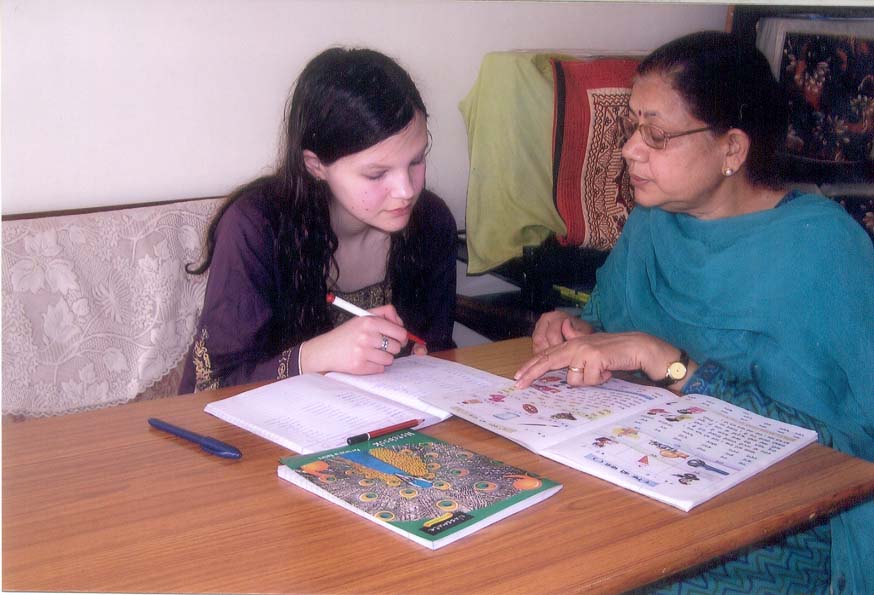
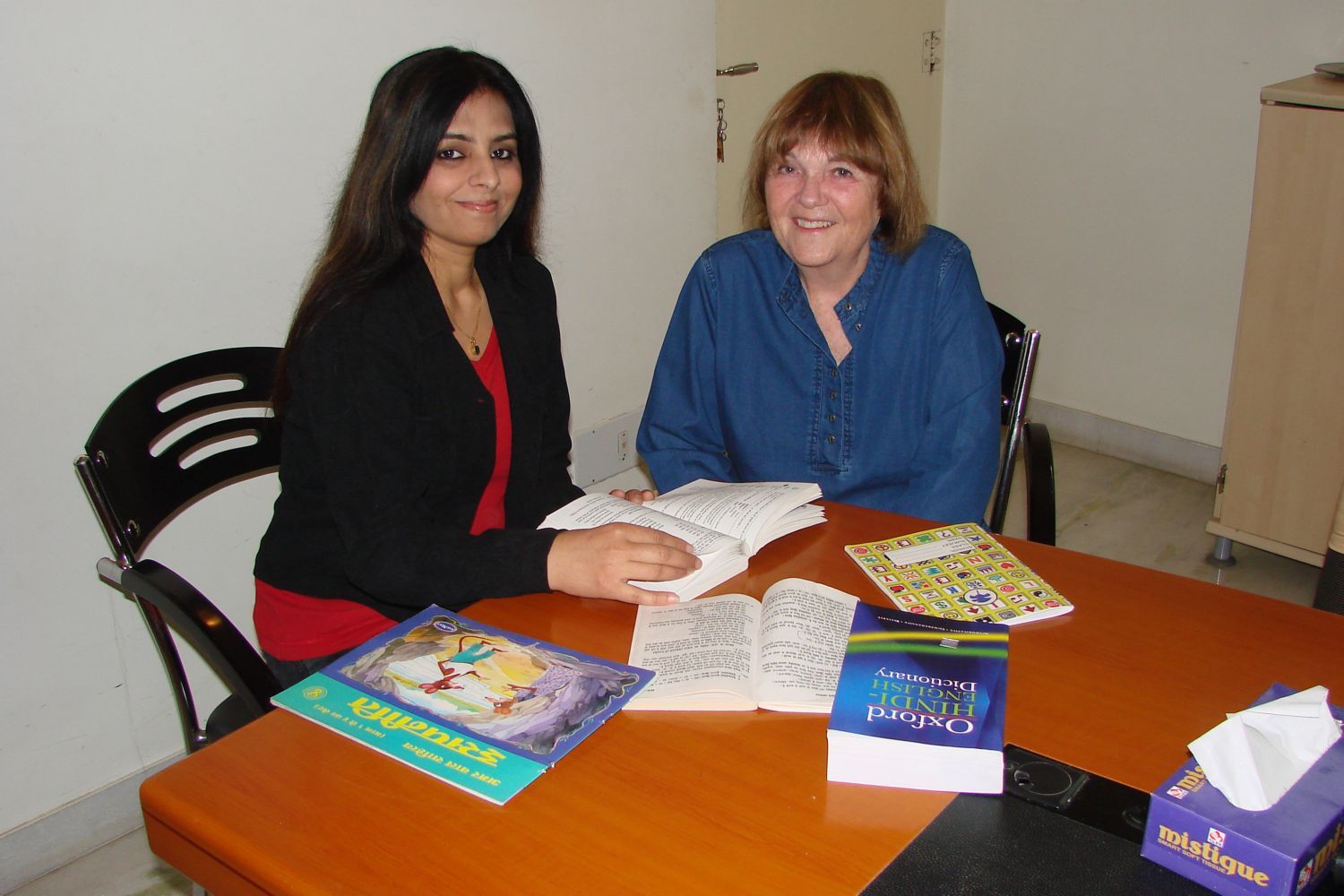
We offer unique one-to-one Hindi lessons and courses
for individual and small groups in Jaipur by
University-educated experienced Native Teachers with
the facility of Staying with an Indian family.
We are offering private language courses and normally
these courses are taken by the hobby students from
different countries. A foreign student / participant
of our course will get a teaching certificate from the
teacher/instructor about the language lessons he/ she
has taken.
Hindi Courses for beginners and advanced learners are
also offered. During this intensive course, you will
have the opportunity to practice Grammar, Reading,
Speaking, and Listening with the help of your
individual teacher. It is expected from the
participants to devote enough time to practice the
language after the classes so that the pace of the
course can be maintained. You are welcome to take a
trial class at our Center in Jaipur or online.
For whom is this kind of one-to-one individual
Hindi language course suitable?
Our one to one course is suitable for those who want
to learn the language quickly and seriously. Also for
those who may have tried the group classes at private
institutes, colleges, or long-term part-time classes
at the Universities but still do not have the desired
result and are unable to speak Hindi up to their
expectations.
Our teachers caters to the need of every student
individually and you save a lot of time due to the
intensive and unique nature of our Hindi courses.
This course is thought for those who are ready to put
serious efforts to learn the language. Our goal
remains to make the students speak the language and
attain knowledge of all aspects of the language within
the chosen period of time. The student may be needed
to have a practice of at least 3 to 4 hours at home
after his / her individual classes. This way the
participants achieve some times better Hindi learning
than even during the one-year regular course
in a
University classroom!
What level of courses are offered?
Participants can take any level, of course, depending
on their personal needs. Our Hindi classes basically
are divided into four Levels (Level 1 is the basic
level for the beginners and level 4 is the advanced
level).
Below are some of the details of the Courses Levels
offered by us
LEVEL 1 - Duration 1 month (3.5
hours of individual one to one intensive classes five
days a week)
Level 1 thought for the beginners. At the end of LEVEL
1, the foreign students will be able to use the Hindi
Language for their basic needs. During the first
level, the emphasis remains on learning basic grammar
in easy steps so that the student does not feel
complicated while learning this new language. Some
basic letters and texts can be written by the end of
this level. Some of the students are also able to
speak Hindi sentences.
LEVEL 2 - Duration 2 months
(3.5 hours of individual one to one intensive classes
five days a week)
Those who have done Level 1 can start with Level 2.
During Level 2 you will be taken deep into the Grammar
and its logical structure so you will be able to read
the Hindi texts and understand their meaning. During
the Level 2 emphasis is given to Reading, Writing,
Listening, and speaking. During Level 2 You prepare
yourself for the day to day life using Hindi.
LEVEL 3 - Duration 3 months
(3.5 hours of individual one to one intensive classes
five days a week)
Those who find
themselves already comfortable with the Hindi Grammar
and can speak and understand Hindi can go for Level 3.
During this course, you will be doing a lot of
speaking and reading and some tricky parts of Hindi
Grammar will be explained. Day to Day slang use
language will be made known to you and how and when
you use them. By the End of the Third Level, Students
can read & Speak Hindi with proficiency and can manage
their daily life on their own. By the end of the Hindi
level 3, the participants will only need to practice
further. All the Teaching parts will be completed
during this course. By the end of this course, you
would have completed more material and learning than a
normal 1 year Hindi course in a college or at a
university.
LEVEL 4 -
Duration 3 months (3.5 hours of individual one
to one intensive classes five days a week)
This is the highest level and is suitable for those
who are already well versed with the language and
would like to understand and produce the language to
satisfy the demands of academic and professional
fields. By the end of this course, the Hindi Course
participant will have an excellent command of
idiomatic expressions so that spontaneous
communication with a high degree of precision is
possible with the native speaker.
How does it work with one-to-one individual classes?
How does it work with one-to-one
individual classes?
You will be taught by an experienced private (mostly
female) teacher and the classes will either be in a
classroom or at the teacher's home. If accommodation
is not available at the teacher, home then only 10 -
15 minutes within walking distance from your homestay.
Hindi sessions are for five days a week and in total
for around 3.5 hours a day. You will be the only
student at a time with the teacher. If you happen to
be more than one participant and prefer to learn
together you will be taught as a small group with
specific attention to every individual.
When does the course start – what are the dates?
As our unique one-to-one individual Hindi lessons with
the Home Stay facility is a privately organized course
thus it offers you the great flexibility of choosing
the desired dates you would like to start with the
Hindi classes. We recommend you to choose the dates
yourself and check with us if on the desired dates we
have a teacher available for you. From October till
March our individual Hindi classes are mostly booked
well in advance so we recommend you to check with us
well before your intended arrival. If we are booked on
your desired dates we would suggest you the next
available/alternate dates.
Where shall I stay
during the Hindi Language course?
We could accommodate
you with a small Hindi & English Speaking Indian
family or at the Home of your Hindi Teacher where you
would be provided a private room with a private
bathroom and toilet. The room will be
air-cooled/air-conditioned. Most of our home Stays
also have Wifi Internet at their premises. Home Stay
facility for Hindi learners is part of our unique
program to enable Foreign students to practice their
Hindi knowledge with native speakers while also
getting acquainted with the day-to-day culture of
India. We choose our host families carefully and they
are not far away than 10 - 15 minutes walking distance
from your teacher's classroom. We prefer to make our
students stay with the Hindi teacher's family.
Please note you will be taken care of by your teacher
as well as by the Hoist family you would stay with. We
do not expect you to be out of the house in the late
hours unless informed to the host family. You would be
given the phone. numbers of the house as well as the
mobile of the host family so that you can be reached
by your family at any time. We also expect you to let
the host family know about your contact number etc.
Some of the pictures of our host family's houses are
available
here!
Some of the Reviews are also available on Trip Advisor
at
Indo Home Stay - Jaipur
Where can I have my meals etc. during the classes?
Where can I have my meals etc. during the classes?
Providing a rich culinary experience is a part of our
unique one-to-one individual Hindi lessons with Home
Stay. We want you to spend your valuable time on Hindi
learning and therefore your host family will take care
of all your three meals, tea, coffee, etc. and your
laundry will be taken care of once a week. Please also
note that most of the host families cook only
vegetarian food at home so you will have an
opportunity to experience the very rich vegetarian
Indian Kitchen during your stay with an Indian Family.
How much would the unique one-to-one individual Hindi
lessons with the Home Stay facility with Hindi
Speaking Indian family cost?
Our unique one-to-one
individual Hindi lessons with the Home Stay facility
cost would depend on the dates and accommodation you
choose to stay during your course. However, these
courses are considered a very good value for money
considering the below inclusions:
 Hindi Classes 5 days a week for around 3.5 hours a day
Accommodation at an Indian family with your own room
with a private bathroom and toilet, cold & warm water
The given cost also includes breakfast, lunch, and
dinner as well as tea & coffee, laundry once a week,
Internet via Wifi
Textbook (Necessary training materials for the student
(after assessing the student’s current Hindi level),
Grammar workbook, Bilingual dictionary (Hindi/English)
The fee of the instructor (university educated)
Should you like to have classes for a lesser period
than one month the cost would be reduced accordingly.
You can also take a trial class just for one day and
then decide if this is the kind of session you are
willing to continue!
If you have your own arrangements of accommodation and
are just interested in the Hindi classes we can offer
you the class of 60 min (minimum of two hours a day).
Note: Please get in touch with us for special
discounts for groups etc.
(query)
What can I do at the weekends?
Weekends are the opportunities to relax from classes
though it is recommended to revise the material on
your own at least for 2 hours a day.
We can organize the following activities for the Hindi
Students / Participants:
Yoga, Meditation, Ayurveda Consultancy, Meeting with
Astrologer, Indian Cooking.
Sightseeing programs, Car Rental with Chauffeur, tours
to nearby attractions as well as long tours at the end
of the
course.
Culture and shopping tours, Visit Women's
organizations, visit Farms and Markets.
Interaction with local people from all walks of life.
What is your exact location and contact Details ?
Our Location is
(Indo Hindi Classes, 312 /06, Valmiki Marg, Raja Park,
Adarsh Nagar, Jaipur 302004, Rajasthan, India).
You can always contact our head Language instructor
Suman Minglani directly on WhatsApp: at +91
97843 56686
or email her
and she will revert within 48 hours.
How shall I reach you from Delhi
International
Airport?
Most international
flights to India land at the New Delhi Indira Gandhi
International Airport but many also at
the Jaipur international Airport. The city of
Jaipur
is around 250 km by road from the Delhi
International Airport. There are also a few direct
flights from Delhi Airport to Jaipur. From Jaipur
Airport we / your host family will pick you up or you
can also opt for the option of being picked up from
the Delhi International Airport and driving to your
Host family for nominal charges. Our driver will be
waiting for you at the Exit Gate with your name on
board and drive you to your host family in Jaipur. The
drive to Jaipur may take up to 5-6 hours. For further
travel arrangements, you can contact our travel
consultant.
I still have some questions which have not been
answered!
Before you start our unique one-to-one individual
Hindi lessons with the Home Stay facility we would
like you to be updated with all the information you
wish to have. Please do not hesitate to ask us
questions. You can send us an email and we will revert
within the next 48 hours. We look forward to welcoming
you!
|
 |
 |
 |
 |
|
|
|
|
Advantages of learning Hindi
|
|
Hindi is the national language of India and
is spoken by almost half a billion people in India and in the
rest of the world by migrated Indians. Hindi is the second
most spoken language in the world after Chinese. It allows one
to communicate with a far wider variety of people in India
than English which is only spoken by around five percent of
the population. Hindi became the official language of India on
26th January 1965. Hindi is an Indo-European language, of the
Indo-Aryan subfamily. It derives much of its formal and
technical vocabulary from Sanskrit. With independence, a
common language had to be decided. The matter was put to vote
and Hindi won by a single vote. Hindi, however, was only one
of the many regional languages of India. Various famous
epics and plays were written in Hindi like Ramacharimanas,
Bhagvad Gita, and the Mahabharata. Today, Hindi is widely
spoken in almost all the states of India, especially in the
states in northern and central India. Hindi is spoken exactly
as it is written so it is very easy to learn and read. Hindi
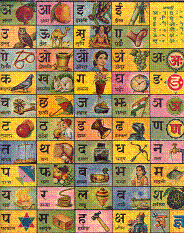
is normally spoken using a combination of 52 sounds, ten
vowels, and 40 consonants. There are 11 vowels and 36
consonants in Hindi. With the knowledge of Hindi, you can
easily know about Indian culture, religion, and current
affairs. English also continues to be an administrative and
official language of the central Government, besides Hindi.
Although you may not be stuck up anywhere in the country if
you are familiar with English, it is always desirable and
enjoyable to know a few words of the local language - in this
case, Hindi - to communicate with the common people of India.
Indo Vacations offers different courses in Hindi in
association with experienced instructors in India and abroad.
The courses are of different time duration that can be
designed as per the interest of the student/course participant
and the availability of the teacher. The offered Hindi
Language lessons are given by private teachers thus making the
teaching sessions individual and one-to-one basis. You are
free to ask questions, take your time at the exercises and
practice the sentences as long as you and your teachers are
satisfied with the pronunciation. We would design the course
and find the right teacher for you. Our teachers have
experience in teaching foreign students whose native language
is not Hindi. We offer daily 3.4 to 4 hours classes which are
divided into two sessions. We normally arrange your
accommodation either at the teacher's home or within 10 -15
minutes' reaching time by walking to your teacher so that you
both can coordinate the timings as per your convenience and
you save precious time as well as money on traveling. At
present we offer language courses in Jaipur, the capital of
the famous colorful state of Rajasthan in India. Jaipur lies
approximately 270 km south of Delhi, the capital of India. We
would arrange your transfer from the Jaipur airport without
any cost and from the Delhi International Airport on nominal
charges if wished so. We could also assist you for any other
tour travel services needed by you. During the classes we
recommend you to stay with an Indian family to experience the
real Indian culture and Indian way of living. The cost of
language courses will be informed to you once we have the
desired dates from you as the cost of the accommodation varies
season to season. The cost of the Hindi Language course with
Home Stay includes the following: 5 days of classes in a week
(around 3.5 hours a day with accommodation for one month at an
Indian family with your own room with bath and WC, round the
clock cold & hot water). This also includes breakfast, lunch,
and dinner as well as tea & coffee. Your laundry will be taken
care of and use of the internet at the premises itself is
possible. If you wish to take a shorter course than one month,
please send us your
query and we would revert with the availability and
applicable charges.
Here are some of the pictures of one of the Home Stay where we
offer the accommodation of Hindi Students if they wish to stay
with an Indian family
(pictures)
|
Our Hindi Students Start speaking Hindi
just after a few days
of their individual Lessons
(Watch Videod
below)
|
|
|
|
|
|
| |
|
Students
Feedback
about
our
individual
Hindi
Classes
(More
feedback is available from Students from many countries -
Please ask us for references from you country)
|
|
----- Original Message -----
Sent: Saturday, January 05,
2008 7:56 PM
Subject: Thank you!
Namaste!
May I wish
you and your family a Happy New Year! Thank you for the
two pictures, they are lovely.
I had a good
time in Jaipur, and your attentiveness to my needs was
very efficient throughout my stay. I really enjoyed
learning Hindi; the way I was taught was good, and my
teacher really looked after me! As well as teaching me
Hindi which was tailored to my personal needs, she also
took me shopping, to the park, taught me some yoga, let
me try new foods, and invited me for a meal on Christmas
Day. I also enjoyed my trip to Ladli and being hennaed.
The place where I stayed was lovely, and the location of
it was so convenient. It was good to have the experience
of living with an Indian family. All of the travel
arrangements ran very smoothly.
I have
attached a picture of me in my new sari!
I am already
thinking about my next trip. I'm interested in returning
to Rajasthan and visiting Gujarat as well.
Best wishes,
Lizzie
|
|
 |
|
|
|
----- Original Message -----
Sent: Thursday, November 06,
2008 9:23 AM
Subject: RE: Learning Hindi
Dear
Sanjeev,
my feedback is extremely positive and if all goes well I
hope to see you all soon in 2009.
I really enjoyed the lessons although I had very little
time - but I did make good progress esp. as I did not do
anything for over 1 y.
The teacher is really nice and very experienced.
Looking forward to my next India experience.
Thanks so much
Karin |
|
|
|
----- Original Message -----
Sent: Saturday, March 21, 2009
8:30 PM
Subject: Hindi
Classes at Jaipur
Dear Sanjeev,
Just noticing that I have safely arrived at Tokyo this
morning.
The travel has been very comfortable with each day being
so exciting!
Please say hi to Mr. Sony and Suraj (I think I haven't
said proper
good bye to her!), and pass my best wishes. Of course,
biggest thank
you goes to Mr. Sanjeev Minglani. THANK YOU SO MUCH for
your very
original hospitality.
For a moment, I am sending you some photos taken at home.
I will get in touch when more things are available online.
Best wishes ...and keep in touch ^_^
Ayako |
|
|
|
---- Original Message -----
Sent: Saturday, April 18, 2009
1:38 PM
Subject: Namaste:-)
Dear Suman, dear Sanjeev,
now I finally find some minutes to write you from Germany
and to thank you again for the wonderful time I could
spend in Jaipur.
Since I am back, university doesn’t allow me to enjoy any
freetime. But anyway I enjoy my work. Right now we already
started the preparations of my big fieldtrip and I am
already counting the days until I can leave for Sri Lanka
and India. It’s just three month and three days;-) But
before there will be a lot to do...
But even beside my work, I found a possibility to continue
(at least a bit) to learn Hindi here in Heidelberg. I am
attending two hours per week a course that is called
“Hindi for Anthropologists”. Right now it is just a
repetition of the things I learned in Jaipur, but at least
it helps me to keep things in mind:-) Further, my
colleagues from India frequently check my knowledge (and
have a lot of fun when I make some mistakes;-))
I should also greet you from my professor. He was really
happy, that I got such excellent lessons during my trip
and he was even more surprised, when I gave him your
present. He really likes the pictures and they now have a
special place in his office. Same with the beautiful
picture you gave to me. It got a special place in my
living room.
So, please say hello to everybody (to Ria, Veena, Prem,
Ruci, Adi...). I miss all of you!!!
Take care & Hope to see you soon.
Best wishes,
Silke
(Uni.
Heidelberg) |
|
|
|
----- Original Message -----
Sent: Tuesday, November 03,
2009 12:54 AM
Subject: Danke!
Lieber Sanjeev,
liebe Suman, liebes Team von Indovacations,
ich möchte mich noch einmal ganz herzlich für meinen
wunderschönen Aufenthalt in Jaipur bedanken! Meine
Ausflüge waren immer bestens organisiert, meine
Gastfamilie war einfach phantastisch und der Hindi-Kurs
sehr effektiv (ich lerne jetzt fleißig zuhause weiter und
stelle mir die üppigen Pflanzen der Pushpawali dabei vor...).
Besten Dank auch für die vielen Geschenke zu Diwali und
zum Abschied, für das unglaublich leckere Abschlußessen,
für alle beantworteten interkulturellen Fragen und für Rat
und Tat in allen Lebens- und Reiselagen...
Alles Gute Euch allen! Ich freue mich schon auf ein
Wiedersehen!
Viele Grüße aus Bamberg,
Nicole Grom
-------------------------
Nicole Grom M.A.
96047 Bamberg |
|
|
|
----- Original Message -----
Sent: Monday, March 15, 2010
5:34 PM
Subject: RE: your feedback on
the Hindi classes !
Dear Sanjeev
Thank you
for your email. I had a fairly good trip home, and have
been busy the last week 'catching up'!
I was very
pleased with the classes provided by Suman.
I was
planning on returning in October, but the weather for
November seems to be much better (and nearer to
February's weather), so I may return then instead.
Would you agree the weather is less hot then?
Regards
Namaste
Hartley
|
|
|
|
----- Original Message -----
Sent: Tuesday, March 30, 2010
5:27 PM
Subject: Greetings from
Germany
Hallo
Sanjeev,
Viele liebe Grüße aus
Deutschland! Ich hoffe Dir und deiner Familie geht es
gut.
Es tut mir
wirklich sehr leid, dass ich mich nicht mal früher gemeldet
habe. Seit meiner (perfekt organisierten) Indien Reise
vor einem Jahr war ich sehr beschäftigt und es ist sehr
viel geschehen.
Nach meiner Rückkehr nach
NY hatte ich eine sehr erfolgreiche Fotoausstellung von
meinen Indien Bildern. Dann habe ich meine Diplomarbeit über Indiens
wirtschaftliche Entwicklung fertiggeschrieben und habe
im Juni meinen College Diplom bekommen. Seit September
wohne ich mit meiner Freundin in Berlin und studiere/arbeite
hier.
Auch wenn es schon ein Jahr her ist, muss ich mich
einfach noch einmal dafür bedanken wie perfekt Indo
Vacations die Reisen fuer mich und meine Familie geplant
hat. Selbst in den abgelegensten Gegenden in Sikkim oder während dem
Holi Fest in Varanasi habe ich mich immer sicher und gut
beraten gefühlt!
Wenn Ihr
Anfragen von potentiellen Kunden bekommt und eine
Empfehlung braucht kannst du gerne meine Email
weitergeben.
Ansonsten hoffe ich, dass es euch in Jaipur gut geht und
Ihr viele Kunden habt.
Ich vermisse
vor allem das Drachensteigen in Indien. Ich habe zwar
viele Drachen und auch Schnur nach Deutschland
mitgenommen, aber hier gibt es niemanden der mich zu
einem Kampf herausfordert :-)
Ich hoffe, dass ich vielleicht diesen Sommer (August)
mal wieder nach Indien komme, um wieder zu Fotografieren
und noch mehr Hindi zu lernen. Aber ich habe noch keine
genauen Pläne. Wenn es soweit ist werde ich bestimmt
wieder etwas über Indo Vacations buchen.
Viele Grüße und
ich freue mich von Dir zu hören.
Tobias Leeger
|
|
From:
Michael Lacyk
Date: 15 October 2011 23:40
Subject: feedback
To: Indo Vacations
Namaste! I'm happy to provide some feedback:
"I chose an Indo Vacations package for an intensive Hindi
program after thoroughly researching several schools and
travel operators in India. My program was taught by an
experienced and patient teacher who was willing to design
a language program to fit my needs. I was a guest in the
home of a wonderful local family who made me feel welcome
and relaxed. The food was always delicious and the
accommodations were very clean and modern. Because of
this environment, it was easy for me to concentrate on my
studies and still have ample time to explore Jaipur and
Rajasthan. After a few weeks, when I had time for more
exploration, Indo Vacations was able to offer me several
interesting tour options that allowed me to experience
more of the regional culture. I recommend this company
for anyone interested in visiting India for almost any
reason (Hindi lessons, cooking classes, etc.) because of
the professionalism of the staff and the care they take in
ensuring everyone a memorable and rewarding trip."
- Mike L., Washington DC, USA
|
Namaste, sehr geehrter Herr
Minglani,
........Was meinen Hindi-Kurs angeht, bin ich sehr
zufrieden. Ich hoffe, dass ich
meine aufgefrischten und neu erworbenen Kenntnisse gut
einsetzen kann. Ich
überlege auch, ob ich in einem oder zwei Jahren einen
weiteren Aufenthalt in
Indien absolviere, um mich weiter zu qualifizieren. Dazu
werde ich aber erst
einmal checken müssen, was hier in Deutschland an
Weiterbildungsmöglichkeiten in Sachen Hindi zu bekommen
ist. Und dann muss
ich das auch systematisch vorbereiten.
Inhaltlich war der Sprachkurs sehr gut. Da wäre zunächst
einmal das reale
Leben in einer indischen Familie, was man ja so auch nicht
täglich
kennenlernt. Dann die gute Auswahl meiner Lehrer, beide
sind nicht
irgendwelche Wald-und-Wiesen-Dozenten, sondern verfügen
über Lehrerfahrung
und Lehrmaterial. Die Intensität war genau richtig, es war
anstrengend, aber
nicht aufreibend.
Herzliche Grüße aus dem "kalten" Deutschland, hier wird es
dieses Jahr
überhaupt nicht richtig Sommer.
Ihr
Nils Gajowiy
You may wish to have a look at our references from different countries at:
References
|
|
The glossary that follows lists some important Hindi words
with their English translations – words you may hear often
during your visit to India:
|
Hindi
Word |
English
Meaning |
|
Acha |
Ok |
|
Acharya |
A revered teacher |
|
Ahinsa |
Non-violence |
|
Ashram |
A spiritual retreat |
|
Ayurvedic |
Indian herbal medicine |
|
Bahhut Accha |
Very Good |
|
Bagh |
Garden |
|
Bahadur |
Brave |
|
Baksheesh |
Tip |
|
Bandar |
Monkey |
|
Bandh |
General Strike |
|
Baaen |
Left |
|
Bada |
Big |
|
Berra |
Waiter |
Click here to know More Hindi
Words--- |
|
|
|
|
|
 Hindi Learning and culture immersion programm
in India for student groups Hindi Learning and culture immersion programm
in India for student groups
|
|
Our team has prepared a Hindi Learning and culture immersion
program in India for student groups and we have given more
details in the day-wise tour itinerary as given below. The
teaching schedule of our language instructor will be quite
flexible with respect to language and Indian culture teaching.
He/she will cover various aspects of the social, cultural, and
religious life of India. We will provide the teaching material
to very individual. We will also make the cloth washing
arrangements for the students twice a week. We have included
in the below tour program various cultural activities like
Yoga, Ayurveda, cooking classes, visiting temples, dinner in
an ethnic village, and various additional excursions (details
are mentioned in the tour itinerary). Should you have any
further suggestions or wish to make changes please feel free
to tell us. For this new tour, we will also provide an
English-speaking tour escort who will accompany the group to
everyday activities. The Accommodation to Students is provided
normally on a twin sharing basis however as per your specific
needs we can also provide a double room sharing basis. |
|
Day 01 – Flight to India (New Delhi)
Around midnight arrival in
Delhi.
The cosmopolitan
city and capital
Delhi is the main gateway for travelers. You are met by an
Indo Vacations representative and transferred to the hotel.
Day 02 – New Delhi
In the morning we have sightseeing in Old Delhi. We take a Rickshaw
Ride parallel to the
Red Fort
through the old
city and famous
Silk Road and Silver Bazaar. Sightseeing of Old Delhi includes
"Rajghat", the site where Mahatma Gandhi was cremated and
Jama Masjid, the great
mosque of old Delhi. Today we also visit the famous
"Humayun
Tomb" which is the first substantial example of Mughal architecture in India and
"Qutub
Minar". "Qutub Minar" is 71 meter high and consists
of five stories. In 1199 work began on this tower which was
intended to be the most glorious tower of victory in the
world. This tower was damaged twice and repaired in 1326 and
1368. Before we proceed to the Hotel we drive through the
embassy area in New Delhi where we visit the
India Gate
and see some
impressive Government Buildings.
Day 03 – New Delhi - Jaipur
(about 270 km)
Today we drive to the Pink City
Jaipur.
This city owes its
name, foundations and careful planning to the great warrior
and astronomer, Maharaja Sawai Jai Singh II. Jaipur is the
capital of Rajasthan and famous for its handicrafts and
precious and semiprecious stones. After a break in Jaipur we
visit the
City Palace in the
afternoon which is still the formal residence of the royal
family, built in a blend of the Rajasthani and Mughal
architecture. In the museum of the city palace we visit the
private collection of the Jaipur Maharajas. We continue to
Jantar Mantar,
a stone
observatory, the largest of Jai Singh's five remarkable
observatories. It's complex instruments reveals us the secrets
of medieval Indian astronomy.
Day 04 – Language & Cultural training in Jaipur / City Sightseeing
Today your language and cultural training begins in Jaipur.
Our instructor will start the training with the information of
the next three weeks planning. Learning material like note
books, exercise books etc. will be provided to each student.
In the afternoon city sightseeing is planed. Jaipur is
world famous for its textiles and coloured stones. Enroute to
the old city, we will visit the
Hawa Mahal
(Palace of the
Winds), built in 1799 AD containing 953 small casements with
each having its own balcony. The windows enabled cool air to
circulate and the ladies to watch processions below without
being seen. We also visit the
city palace which is still
the formal residence of the royal family, built in a blend of
the Rajasthani and Mughal architecture. In the museum of the
city palace we will visit the private collection of the Jaipur
Maharajas. We continue to
Jantar Mantar,
a stone observatory, the largest of Jai Singh's five
remarkable observatories. Its complex instruments reveals us
the secrets of medieval Indian astronomy.
Day 05 – Language & Cultural training in Jaipur /
City Sightseeing : Amber (around 10 km)
Today morning we will drive to the ancient capital of
Amber, laying 11 km. away
from Jaipur. Amber was the ancient capital of Kachhawaha
dynasty for 6 centuries before it was moved to newly created
Jaipur. We will ascend to the Palace Fortress on the back of
an Elephant.
In the afternoon there will a lecture on the history of the
state of Rajasthan and the development of the script of the
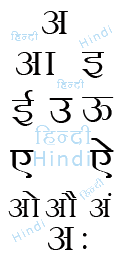
language Hindi (the script of Hindi is also known as Devanagri)
Day 06 – Language & Cultural training in Jaipur
/
City Sightseeing
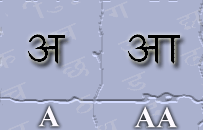
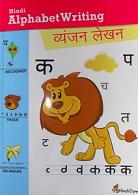
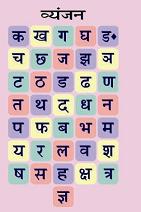
In the late morning hours we will start with first lessons
in learning Hindi alphabets. Our instructor will help you
learning them writing.
In the afternoon we will have a walk in the city and also see
local people working in gemstone factories. Jaipur is
considered as gemstone hub of Asia when it comes to precious
and semiprecious stone cutting and polishing.
Day 07 – Excursion: Bharatpur
(around 174 kms)
In
the morning we will drive to
Bharatpur.
Bharatpur is
known for its Bharatpur Bird Sanctuary, one of the finest bird
sanctuaries in the world. The marshes here are home to over
360 species of birds including the Siberian cranes. Bharatpur
is popular for its bird sanctuary - The Keoladeo Ghana
National Park-finest in Asia. Every year the Siberian cranes
came here to spend the winter in the warmer climate of
Bharatpur. This sanctuary has more than 400 species of water
birds and is also the best spot to watch the exotic migratory
birds from Afghanistan, Central Asia, Tibet as well as
Siberian cranes from the Arctic. In the evening we return back
to the hotel in Jaipur. More details about Bharatpur Bird century
is available at:
http://www.indovacations.net/visitrajasthan/bharatpurbirdsanctuary.htm
Day 08 – Zoo visit in Jaipur ! / Excursion to an ethnic
village Resort
Your day
till noon is free. In the afternoon we will visit the Zoo of
Jaipur. Jaipur Zoo has only the basic facilities but helps
visitors to get a glimpse of the animals and their habitat in
India.
In the evening drive to an ethnic village resort. Presentation
of local music, dance, and various local cultural programs.
The dinner will take place in an ethnic atmosphere and famous
local dishes will be served.
Day 09 – Language & Cultural training
in Jaipur / Sanganer (about 20 km)
Our
day till noon is reserved for the language and cultural
training.
In the afternoon
we drive to Sanganer. Sanganer is famous for its traditional
textile printing and paperwork. Papermaking is practiced in
the Kagazi Mohulla (paper area) and uses waste cotton and silk
rags which are churned into a pulp, sieved, strained, and
dried. The finished products are often speckled with
gold and silver. This traditional work is exported all over
the world.
Day 10 – Language & Cultural training in Jaipur /
Visit a Local Bazar and a Hindu Temple
Our day till noon is reserved for the language and cultural
training.
In the afternoon we will have a walk through the colorful
Bazaar of Jaipur and visit a factory to see the famous block
printing work being done for centuries in Jaipur. After the
walk, we drive through the new city of Jaipur and visit "Laxmi
Narayan Mandir", a Hindu temple made of white marble. We might
have an opportunity here to observe a prayer ceremony.
Day 11 – Language & Cultural training
in Jaipur / Excursion: Nahargarh (about 07 km)
Our day till noon is reserved for the language and cultural
training.
In the afternoon we drive to Nahargarh & Jaigarh. Nahargarh is
also known as the tiger fort and was constructed in the 18th
century to protect the capital. The surrounding hills also
provided good defense. There are excellent views of Jaipur
city from Nahargarh (Tiger hill).
Jaigarh fort
is
situated at a distance of about 15 km from Jaipur. Jaigarh
Fort is also known as the Victory Fort. This fort stands over
a small hillock in the midst of the thorn scrub hills
overlooking the Pink City, Jaipur. Jaigarh Fort was built in
1726 by Sawai Jai Singh.
Day 12 – Language & Cultural training
in Jaipur / visit of local Bazars / Indian cooking lessons
Our
day
till noon is reserved for the language and cultural
training.In the afternoon we will have a walk through the
colorful Bazaar of Jaipur and visit a factory to see the
famous block printing work being done for centuries in Jaipur.
Today we will visit a cooking school and you will get
an introduction to basic Indian cooking and how the Indian
spices are used. The cooked food will be served among the
group.
Indian Food has been rated by most cultures as one of the best
food available. Especially for vegetarians, the travel to
India is half worth
enough only to enjoy the Indian food with its rich varieties.
Indian restaurants have been flourishing in the capitals of
the world and thus, Indian cuisine is no longer a
mystery. More information on Indian cooking is available at::
http://www.indovacations.net/english/Indian-Cookery.htm
Day 13 – Language & Cultural training in Jaipur / Samode (about 40 km)
Our day till
noon is reserved for the language and cultural training.
In the afternoon we drive to Samode. Samode Palace is famous
for its wonderful Darbar Hall (Audience hall) and other parts
of the palace of the Maharaja (king) which are beautifully
decorated with miniature paintings. On special occasions, this
wonderful 400-year-old Palace of Samode is decorated and
fulfilled with traditional dance and music. After the visit to
Samode Palace, we drive back to our hotel in Jaipur.
Day 14 – Language & Cultural training in Jaipur / visit of a Sikh
Temple
In the afternoon we will visit a Sikh Temple in Jaipur!The
Sikhs, derived from the Sanskrit word for "disciples" are
perhaps one of India's most recognizable groups. Sikhs
constitute about two percent of the Indian population. Beards
and turbans give them a very distinctive presence and are both
politically and economically significant. There are Sikhs
living in all the major cities of India and playing an
important role in all India's major institutions. Sikhism is a
fairly new religion, which broke away from Hinduism in the
16th century. More information about Sikhs is available at:
http://www.indovacations.net/english/Sikhism.htm
Day 15 – Language & Cultural training in Jaipur / visit of a
Jain Temple.
In
the afternoon we
visit a Jain Temple in Jaipur !Jainism was started as a reform
movement of the Brahmanic religious beliefs in the 6th century
BC. Its founder was a widely revered saint and ascetic,
Vardhamma, who was later known as Mahavir or the “great hero”.
Mahavir was born in 599 BC just 50 km to the North of modern
Patna near the India and Nepal border. He was about 35 years
older than the Buddha and was also kind-hearted towards all
the living beings. His royal family was also the followers of
an ascetic saint, Parvanatha, who according to Jain tradition
had lived for about two hundred years. Mahavir's life story is
embellished with legends, but there is no doubt that he left
his royal home for a life of a strict ascetic. He rejected the
Hindu belief that the Supreme Creator had created this
universe. He believed that it was infinite and eternal. More
information about Jainism is available at:
http://www.indovacations.net/english/Jainism.htm
Day 16 – Language & Cultural training in Jaipur / Indian
cooking lessons
Our day till noon is reserved for the language and cultural
training.
Today we will visit a cooking school and you will get an
introduction to basic Indian cooking and how the spices are
used. You will learn to use the spices and the cooked food
will be served among the group.
Indian Food has been rated by most cultures as one of the best
food available. Especially for vegetarians traveling to India
is worth only to enjoy the Indian food with its rich
varieties. Indian restaurants have been flourishing in the
capitals of the world and thus, Indian cuisine is no longer a
mystery. More information on Indian cooking is available at:
http://www.indovacations.net/english/Indian-Cookery.htm
Day 17 – Language & Cultural training in Jaipur / Yoga &
Ayurveda
We dedicate our day today to Yoga & Ayurveda (ancient Indian
science to heal sole and body)
There will be an early morning Yoga session under the
supervision of a Yoga Teacher. Breathing Exercises (Pranayama)
& Physical exercises (Asanas) will be explained. There will be
a question-answer session after the practical part and every
individual can obtain information as per their personal need.
More information on Yoga is available at:
www.indovacations.net\english\Yoga.htm
In the afternoon there will be an Ayurveda session. Ayurveda
gives divine prevention from diseases and holy contentment to
the life of an individual. In short, Ayurveda simply explains
the laws of nature that cause disease.
We will visit an Ayurveda clinic and get first-hand
information from an Ayurveda doctor on the way of this ancient
way of treatment. More details about Ayurveda are available at:
www.indovacations.net\english\Ayurveda.htm
Ayurveda body massages can also be arranged for those who are
interested !
There will be a Purification and Good Luck fire Ceremony
(Hawan). This is a holy ritual in the Hindu religion and takes
around one hour. A question – answer session with a hindu
priest / spiritual leader can be organised if wished so
!
Day 18 – Jaipur - Fatehpur Sikri - Agra
(about 260 km)
Today we leave Rajasthan, the biggest state in India, and
drive through a series of fields, small towns, and villages in
the direction of Agra. Enroute we make a stop and visit
Fatehpur Sikri,
which was once an imperial capital frozen in time, constructed
by Akbar the Great in the 16th century. This wonderful city
constructed of red sand stones was abandoned as abruptly as it
had been built. It has been generally stated that it was due
to failing in the water supply. Late evening arrival in
Agra.
Rest of the day at leisure.
Day 19 – Agra (Sightseeing)
We start today our sightseeing with a visit to the
Agra Fort, built by three
of the greatest Mughal emperors. The construction of this
massive structure began in 1565 under Akbar's reign and
continued till the time of his grandson's reign, Shah Jahan
who built the impressive imperial quarters and mosque. After
the visit to Agra Fort,
we proceed to visit the most beautiful monument
in India, the
Taj Mahal, an enduring
monument to love, with a continually fulfilling beauty. It was
built by the Mughal Emperor Shah Jahan between 1631-52, as a
tomb and memorial to his beloved wife Mumtaz Mahal (Jewel of
the Palace), who died at the age of 39 giving birth to her
14th child. We spend enough time at the Taj Mahal
to take this impressive memory home. After the visit
to theTaj Mahal we have a
look at the famous fine marble inlay work which is still being
done in Agra
by the descendants of the families of builders and artists of
the Taj Mahal.
Day 20 – Agra - Delhi
(about 200 km)
After a relaxed Breakfast and a break we drive to
Delhi
Airport to catch the flight back home.
(End of our services)
Our Services
in the tour cost Includes:
1.
Accommodation in standard hotels (2- 3 star facility hotels)
on double sharing basis with bath and WC (with laundry and
fitness center facility)
2. American/continental/Indian breakfast, lunch, and dinner as
buffet, 3 bottles a day per student mineral water every day.
One dinner will be with a presentation of Indian music and
dance in the ethnic atmosphere in Jaipur.
3. Rickshaw Drive in Delhi, Elephant Ride in Amber if
available!
4. Services of a qualified local guide (English speaking) at
every place of sightseeing as well as a tour escort during the
complete travel.
5. Arrangement of a spacious hall where the language classes
will take place.
6. Qualified English-speaking Hindi teacher.
7. All the monument entrance charges as per the program
mentioned above.
8. All transfers and sightseeing throughout the tour by an
air-conditioned car or individual air-conditioned bus.
9. Cooking class, Yoga and Ayurveda classes, study material.
10. All applicable taxes
Exclusions:
1. Any Kind of Personal Expenses such as Tips, Telephone
Bills, and Alcoholic Beverages.
2. Camera Fees (Still or Movie).
3. Any Flight Charges.
4. Transport charges other than the above-mentioned program &
services.
Please drop us a message
to know the cost for the 20 days of Hindi learning and cultural
immersion program ! |
|
|
More on Hindi private
classes and intensive courses................... |
|
|
|



















 Chat
Chat


